
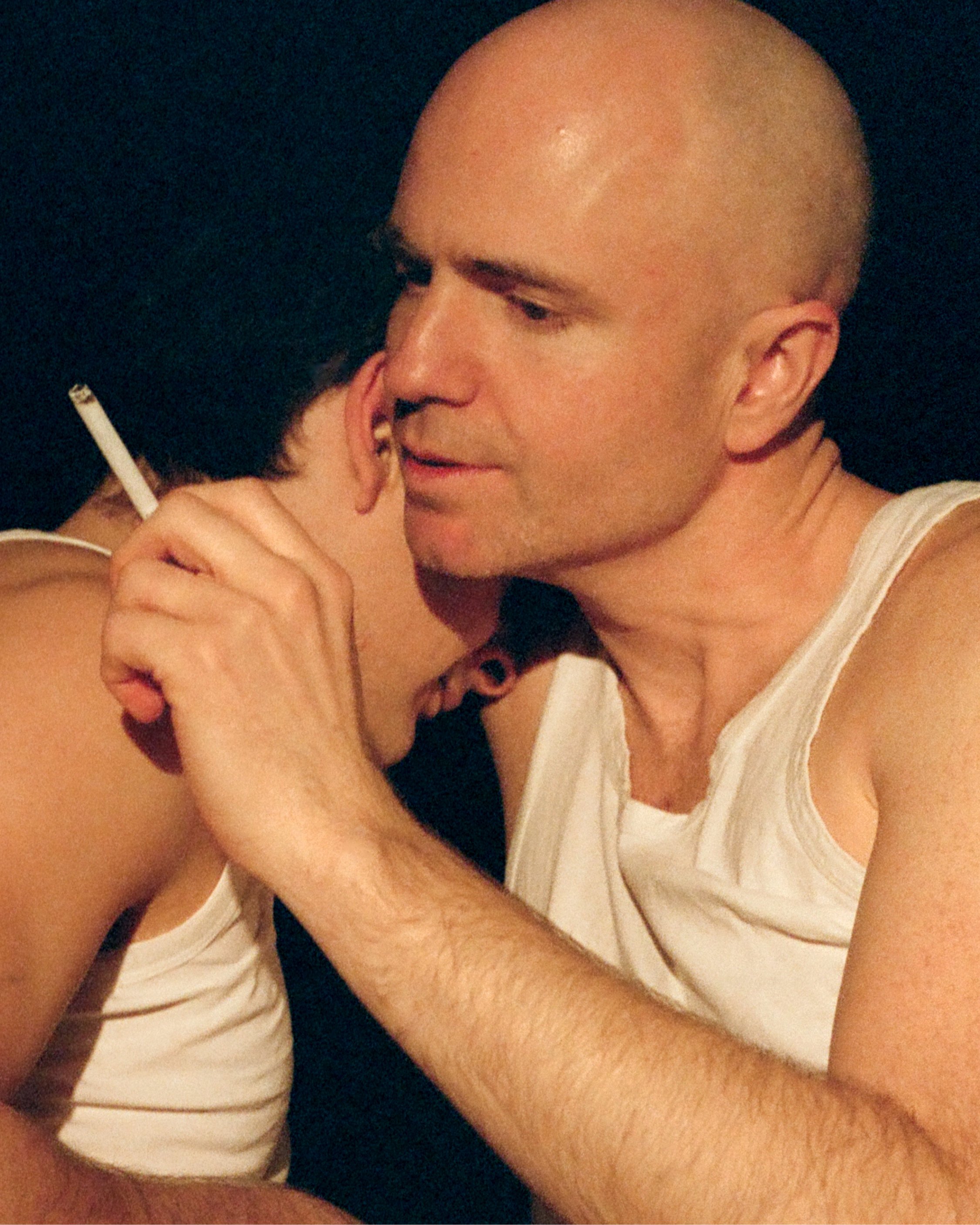
Photo by Hazel Gaskin
Words by Alistair Hall
Given that I don’t believe in the tortured artist anymore, it’s surprising that I decided to write a play about the painter Francis Bacon. He is, after all, the epitome of the troubled, fragile creator that can only make work when cornered by turmoil – even if it's of his own making.
Bacon has long been my favourite painter. I’ve looked for the reasons behind this, I’ve researched his life and I’ve matched some of our own life experiences – but the truth is – when I look at his work – time just stands still. I fall into a sort of trance.
Recently, an art academic I know mentioned that Bacon's work is quite emo. It’s all high emotion, charged atmosphere and moodiness worked into a canvas. For anyone who has ever felt misunderstood, looking at Bacon’s work can be quite cathartic. And I sort of agree.
If I align Bacon’s work with some of my favourite films: Dogville, The Piano Teacher, Moonlight, Birth – the emotional drive feels the same to me. I see a subject seeking escape, permission, identity or searching for total, impossible fulfilment. I feel these threads in Bacon’s work and you’ll find them woven into my new play BUGGERS.
The show is a psychodrama that follows the turbulent, tender relationship between Francis Bacon and his muse and lover George Dyer. Bacon painted Dyer so often that some of his most iconic portraits came from the almost decade-long relationship. If you aren’t familiar with the relationship, then think of Amy Winehouse and Blake but if they were two gay men in 1960s London.
Bacon and Dyer loved to drink and gamble, they loved to fight, they loved to make up, and then fight again and somewhere in between all of the chaos there was an understanding of each other – a deep love that remains a fascinating subject for Bacon fans new and old and has prevailed as an intoxicating subject for academics, art historians and writers – including me.
Bacon and Dyer were from two totally different worlds. Dyer was a working-class man about town struggling with his own identity. When he met Bacon in 1963, Bacon was becoming an international success within the art world and his ego was starting to match the scale of his career. This isn’t a swipe at Bacon. He always had high ambitions for himself, and when the art world began to take him very seriously, I believe a new type of pressure formed around him.
As Bacon fell in love with Dyer, he painted portraits of him all the time. He painted him riding a bike, staring in a mirror, talking or even just crouching. It was clear Bacon was fascinated by Dyer’s very being. This, after all, is a man that embodied all of Bacon’s sexual desires. Dyer was ‘rough trade’, i.e. slang for a working-class guy, a jack of all trades and, in the specific case of Dyer, a man that had been in trouble with the law.
Bacon loved people who were the opposite of his own privilege – he liked to side with those who had known struggle. Whilst Bacon was from a monied family, he had also known struggle and felt misunderstood both by his own family and by certain corners of society – and so he felt a connection with people living on the fringes. And like most artists, particularly queer ones, Bacon found his home in the eccentric, booze-fuelled shadows of Soho. A place where, whatever class you were from, you drank together in sweaty states of hedonism.
The crux of Bacon and Dyer’s relationship was that they were just too different. Dyer struggled with mental health problems and alcoholism. Bacon had a glittering career and a deep artistic focus to tend to, plus he too lived off a cocktail of alcohol and prescription medication. Bacon and Dyer provoked each other’s excessive sides. A couple so seeped in drunkenness or hangover can never really work. Or, as we explore in the play, some couples only ever bring out each other’s unending sense of loneliness.
This I feel is a universal condition, the realisation that no human can ever make us feel fully whole until we really accept ourselves. I don’t think Bacon or Dyer were at this stage during their frantic union. There was tenderness though. I’ve seen photos of the pair on holiday looking so in love, so full of potential. And there is always care, even if in the most troubled relationships.
Bacon thrived off unease and anxiety. The drama of him and George was fuel for his work and though it caused him great emotional and physical pain, he continued to chase it. For him, it resulted in paintings that both he and the art world seemed to connect with.
Dyer famously hated Bacon’s paintings of him and so the toxic cycle of booze, loathing and unfulfilment continued until they started to detach. Dyer set fire to Bacon’s studio, he planted marijuana in his home and then called the police on him which led to a court case and he continued to generally circle Bacon.
I believe they remained on and off, even through all of this, but in October 1971 Bacon had a retrospective at the Grand Palais in Paris. It was the biggest moment of his career, a dazzling, detailed celebration of his work thus far. And he created new works for the show and many of the portraits on display were of George.
Bacon invited him to Paris to join the celebrations – maybe as an olive branch or a sort of closure on their relationship as it was winding down – but the trip ended in tragedy. Two days before the retrospective opened, Dyer died by suicide in a hotel room. He’d taken a cocktail of barbiturates and alcohol. Bacon’s exhibition went ahead and so began the most troubled period of Bacon’s work as a painter.
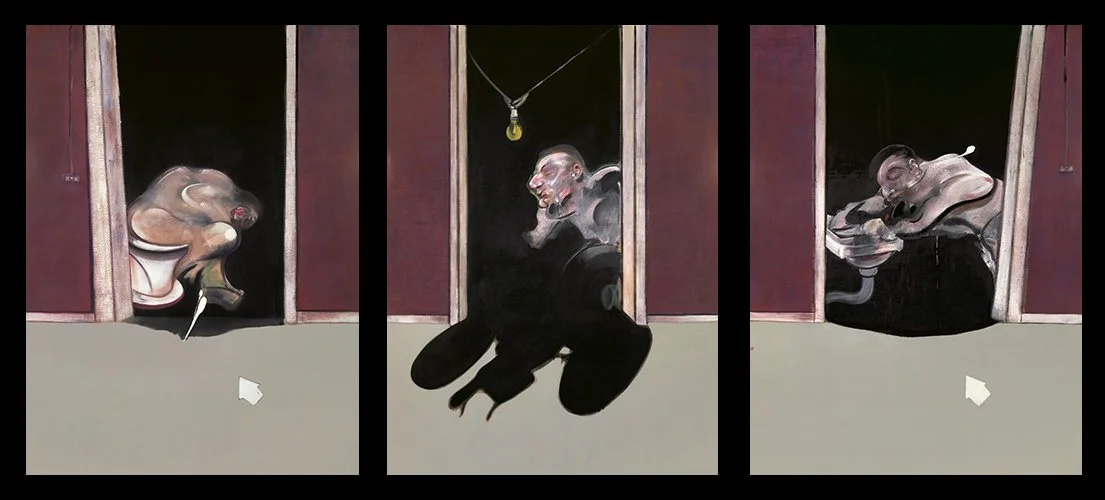
Haunted by grief, he returned to the hotel room where George had died and began to imagine and then paint a series of triptychs of Dyer. Triptych August 1972 and Triptych May–June 1973, to me, are some of the most devastating pieces of work and have been described as some of the most important paintings in art history.
When I say I don’t believe in the tortured artist anymore, what I mean is that I don’t think a life of booze, gambling and prescription drugs is necessary to create art. But, of course, I’m not Bacon. And, post-Dyer, there were calmer moments in the painter’s life that resulted in some incredible paintings that remain just as influential as the work from Bacon’s more pained moments.
Since I got clean in 2016, I have aligned myself with a calmer way of life. One that allows me to pursue my artistic dreams as an actor and writer. From a place of stability, I can delve into worlds that are charged with emotional uncertainty. I can even thrive in them. And then I can come up for air knowing that my life feels changed since I moved away from hurting myself.
But the appeal of darker worlds remains ever potent because this is often where the most truthful aspects of human behaviour are to be found. And from darkness, we can escalate into real freedom and humour. Troubled artists, troubled worlds and trouble in general will always be appealing because of those emotional links I mentioned earlier – longing, identity and deep desire.
Can I imagine a version of events where Bacon sobered up and found himself in 12-step recovery? Maybe not. But I know, through my research, that beneath his penchant for chaos, there was a stable, caring side to him. And it’s this part of him that is just as much the foundation of Buggers as the turmoil.
Buggers will be performed at 1:20pm at Pleasance Courtyard from 5th–30th August at the Edinburgh Fringe Festival.
Booking link: https://www.pleasance.co.uk/event/buggers