
Shoot the People (2025) Review
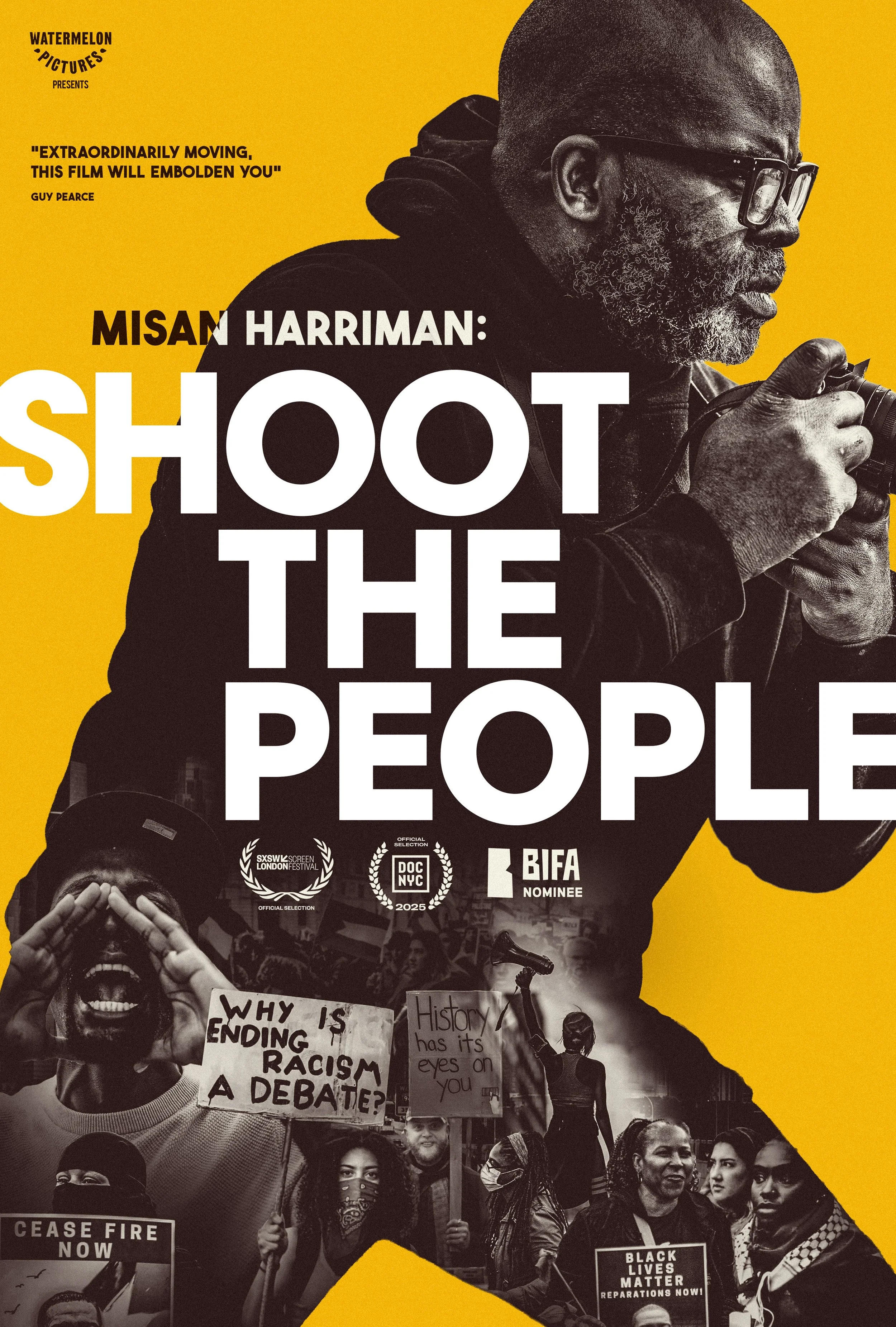
From its opening moments Shoot the People conveys a sense of complete overwhelm. We are drowned in footage of the mass political unrest that has marked much of our recent history. British-Nigerian Misan Harriman watches these various feeds on his phone, mirroring the experience of horror and anxiety many of us felt as we watched events unfolding in real time during the pandemic years. Shoot the People follows Harriman’s work as a photographer and activist, dedicated to using his lens to record various protest movements. He was also the first Black photographer to shoot the September issue of Vogue. We follow his recent rise to prominence, those who have inspired his work, as well as reflecting on the various political protests that his lens has captured. Director Andy Mundy-Castle carefully builds on these narratives as they weave around each other. Using beautifully curated images of Harriman’s own work, as well as various other on-the-ground and news footage, he demonstrates the central thesis of the film; Peter Magubane’s words to protesters reluctant to appear on film during South Africa’s apartheid revolts, that "a struggle without documentation is no struggle."
Shoot the People arrives at an interesting time for Harriman, as it was completed before the recent controversy surrounding his comments on the Golders Green attack, considered by critics to be echoing antisemitic conspiracy theories. His supporters condemn this narrative as a smear campaign leveraged against him by those invested in silencing his voice as an activist. As such, he’s unable to address this within the body of the film, which covers his career up until his nomination for his short film The After and attending the 2024 Oscars.
Andy Mundy-Castle follows Harriman as he elaborates on his rise to prominence as a photographer, his experiences as a Black man growing up in Britain, his inner life, and his passions as an artist. He discusses his dedication to the idea that the political struggles of history and the present are all ones in which we as a collective must choose empathy and solidarity. As such, he uses much of the runtime to talk with those whose voices he wishes to elevate. There is a clear commitment to his belief that his art should be used to allow a platform to those who are central to the various struggles that he captures on camera.
Harriman’s life of wealth and privilege stands in clear juxtaposition to his work as an activist. Many of the causes he champions are ones that are pitched directly against the violence of the wealthy capitalist class, and the mechanics of oppression utilised by capitalism to maintain power over oppressed peoples. It would be all too easy to shy away from this aspect of his life and career entirely, instead keeping focus on his work and the various people he talks to. However, Mundy-Castle and Harriman instead choose to address these dichotomies, with Harriman explaining that he understands from the inside how the deck is stacked against the poor. His intent is to use his privilege to speak out for those voices that are unable to utilise the tools at his disposal.
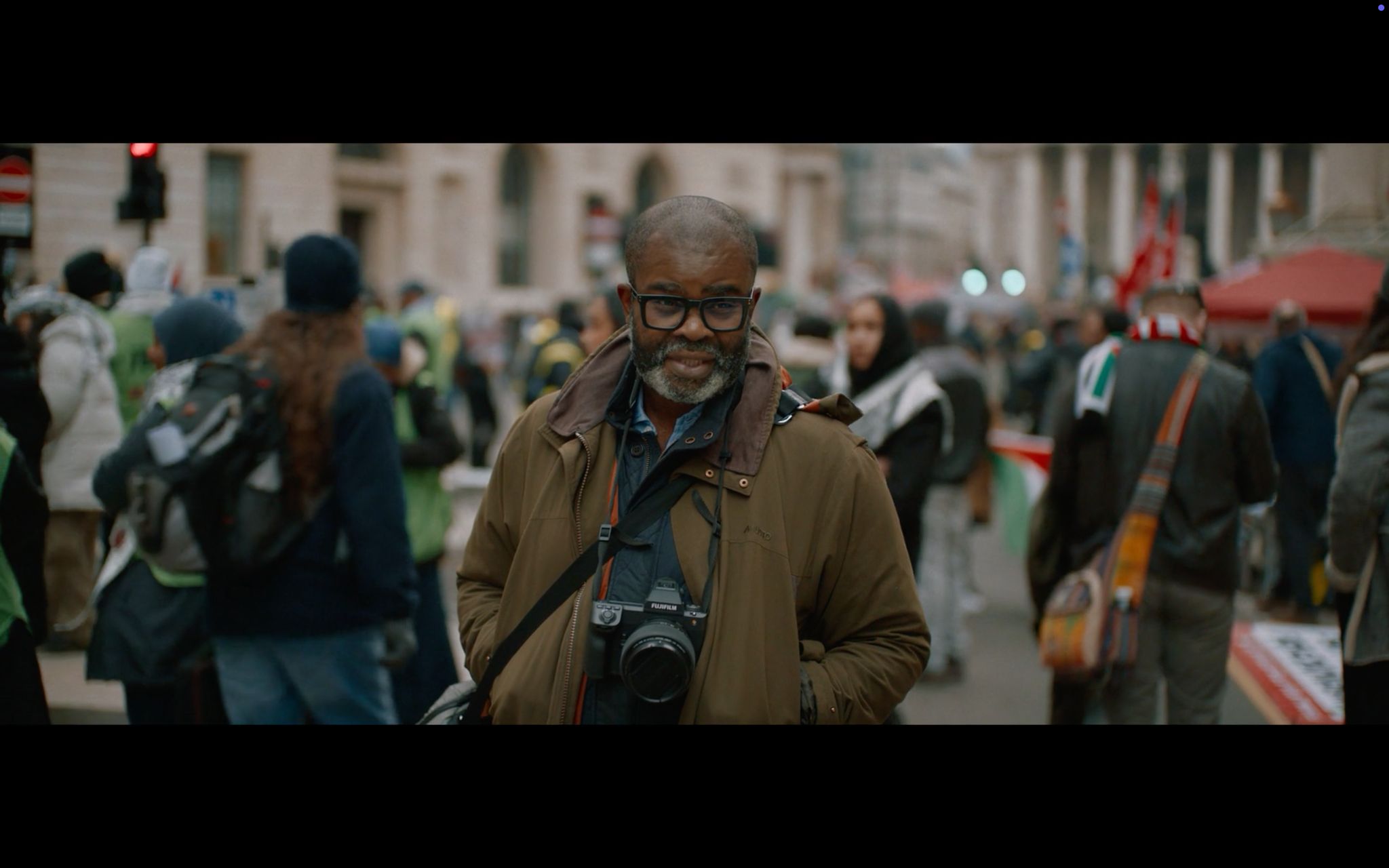
Mundy-Castle jarringly and arrestingly highlights just how critically we could potentially view this aspect of Harriman’s life, interspersing footage of bombings in Gaza between footage of Harriman attending the 2024 Oscars. Large protests calling for a ceasefire in Palestine took place during the event, condemning the Academy’s complicity. Harriman discusses his inner conflict in choosing to go to the Oscars over attending the protests that he had to drive by to do so. It’s a complicated issue to consider, and a difficult tightrope to walk. Though the film touches on Harriman’s attempt to balance his proximity to power and privilege alongside his condemnation of the violence at the system’s hands, it feels a little light in its probing and its conclusions; somewhat understandably in the face of how nuanced such a conversation needs to be.
Where Shoot the People truly shines is in Harriman’s visits with people he admires, and those who have inspired him. Meeting with Ilhan Omar, Martin Luther King III, and visiting the home of Peter Magubane. There he talked with David Meyer-Golan on the legacy of his photography and its importance in recording the struggle for freedom in apartheid South Africa. Certainly the most affecting part of the documentary, Magubane’s work is shown alongside footage of the atrocities committed by the apartheid government against the Black communities seeking liberation. The all too recent legacy of apartheid is shown as still very present, shown to us in the suffering of those seeking reparations. Harriman talks with a frustrated group of poverty-stricken elderly protesters who feel that they are forgotten by the current government. Though there is also reflection on the progress that has been made when Harriman visits Johannesburg University. Where previously the University was only open to white students, now it is open to all, and he attends a protest held there by students standing in solidarity with the people of Palestine.
Mundy-Castle follows Harriman as he travels, observing him as he photographs the anti-racist protests and civil unrest sparked by the murder of George Floyd at the hands of police in Minneapolis in 2020, as well as the various protests campaigning to stop Israel’s genocide in Palestine. There is a sense of weight when we see activists that Harriman meets with at George Floyd Square in Minneapolis. They discuss how they feel there has been a lack of progression and change. But there is also optimism shown in their commitment, solidarity, and determination to fight for those lost and those living. The collective struggles that Harriman highlights all call for mutual solidarity and community. To choose empathy over despair. Mundy-Castle evokes this optimism by highlighting it with swathes of protest footage. We are shown that though the struggle may feel insurmountable, our connections and our collective struggle is one that has the potential to overcome all obstacles. The system itself wishes us to feel isolated and that it is too big to fight, but the communities coming together throughout the world are shown to be larger and stronger than our fears.
Edited with careful intent, and tastefully scored by Nik Ammar, Shoot the People manages to balance its exploration of Harriman’s inner life and his successes, alongside its story of the social justice struggles that his work as an activist focuses on. There is a consistent sense of collective experience and empathy, showcasing beautifully both Harriman’s photography and footage of those embroiled in liberatory struggle. Rejecting the cold and inhuman lens often utilised by more mainstream reportage on protest, the human element is never lost throughout. The call for empathy is made clear, most aptly surmised in the use of a clip of James Baldwin from 1970’s Meeting the Man as the film culminates, where he reminds us, "What you've got to remember is what you're looking at is also you. Everyone you're looking at is also you. You could be that person. You could be that monster, you could be that cop. And you have to decide, in yourself, not to be."
More Info: https://shootthepeoplefilm.com/
Words: Arete Noctua, Film Features Editor & Writer @ Féroce Magazine
Arete is Féroce’s Film Editor, overseeing the magazine’s film coverage through incisive short-form reviews and longer anthology pieces. Their writing explores cinema as both art form and social mirror, examining how iconic films reflect, challenge and shape the cultural moments they emerge from.
With a critical and respected voice in the community, Arete situates film within wider political, aesthetic and historical contexts, drawing connections between screen narratives and cinema history.
Their editorial approach balances close analysis with broader cultural insight, offering readers thoughtful criticism that moves beyond ratings or hype to consider film’s lasting impact, relevance and position within society.