Courtesy of the artist, Photography by Patrick Jameson
Words by Blair Wallace
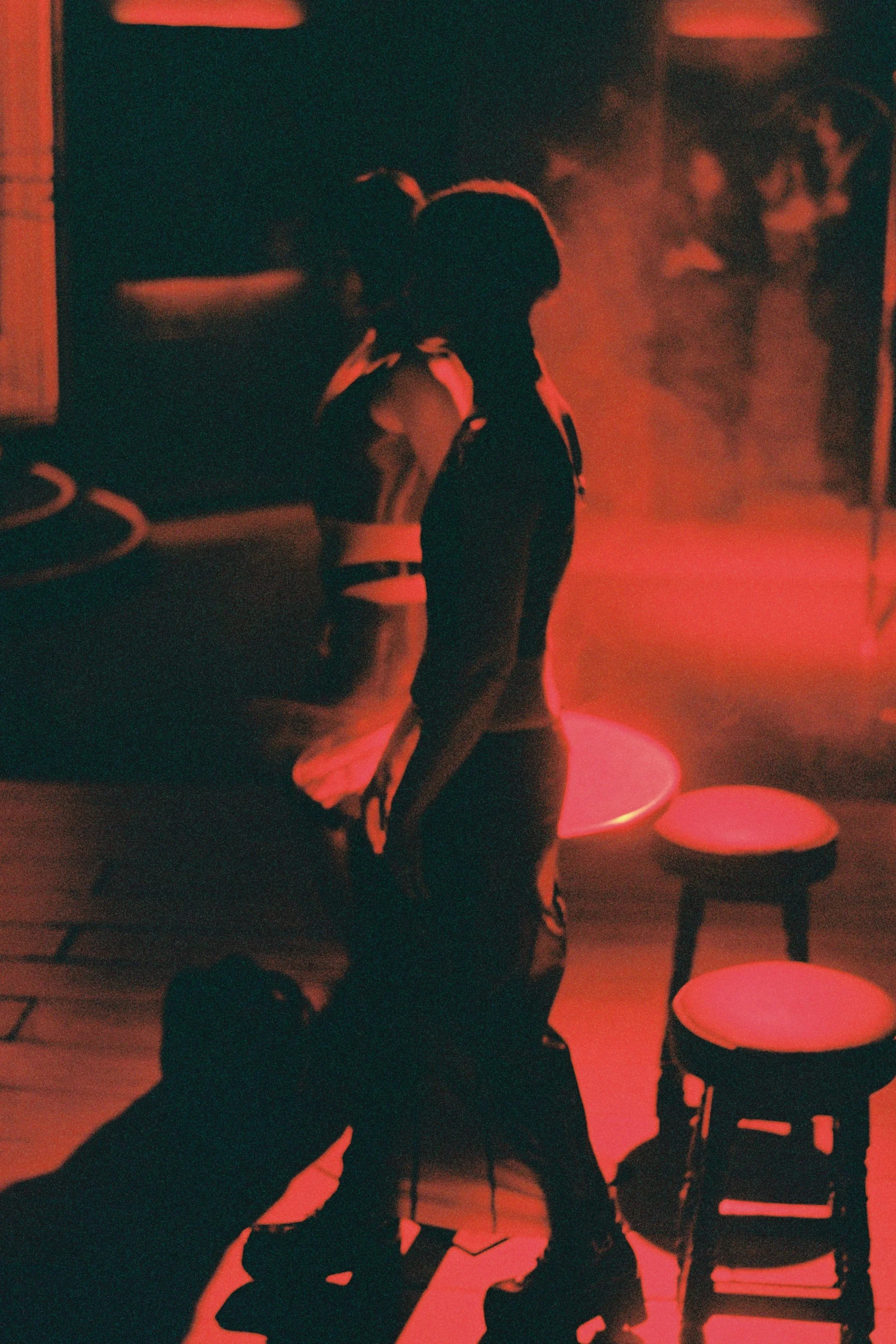
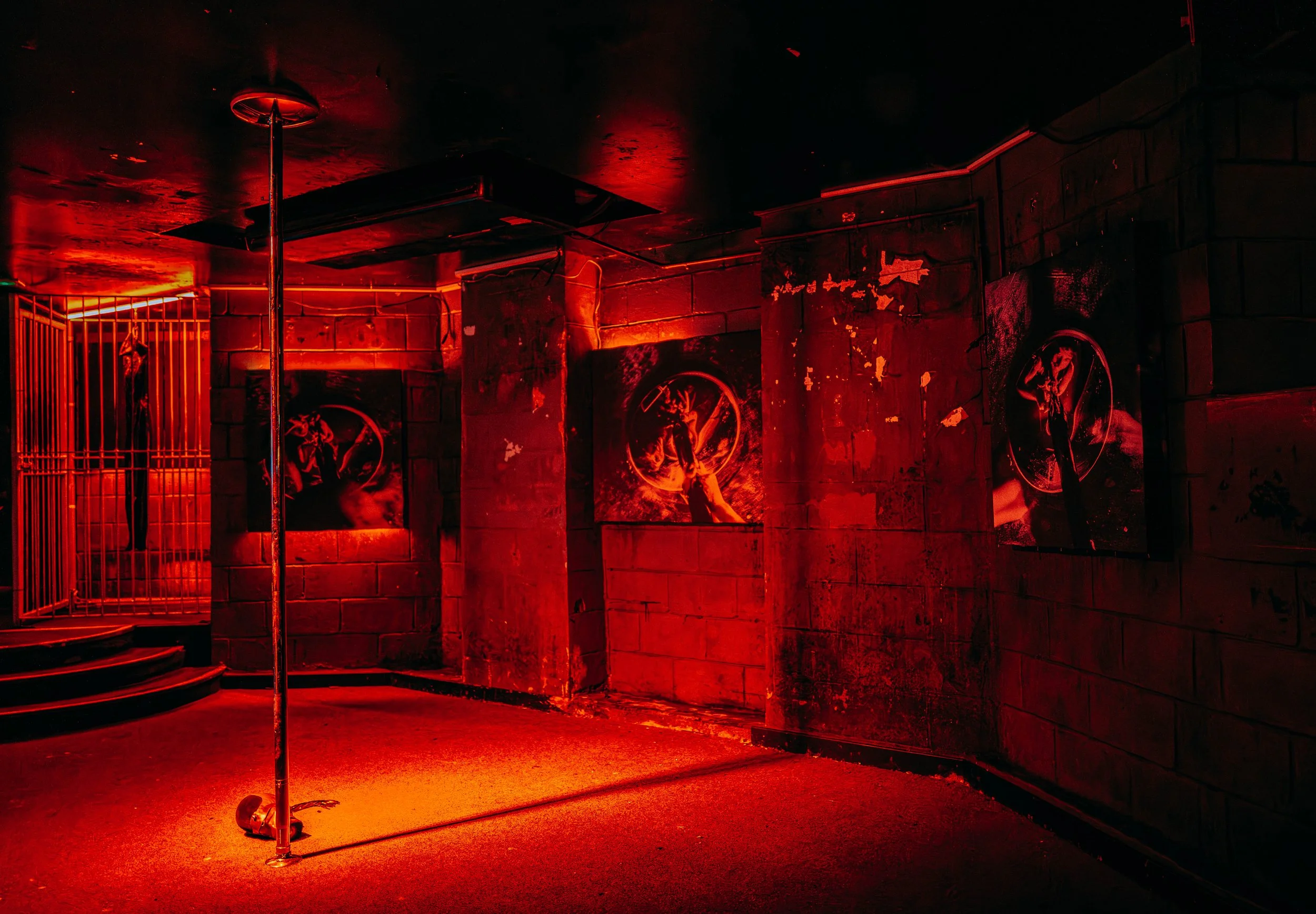
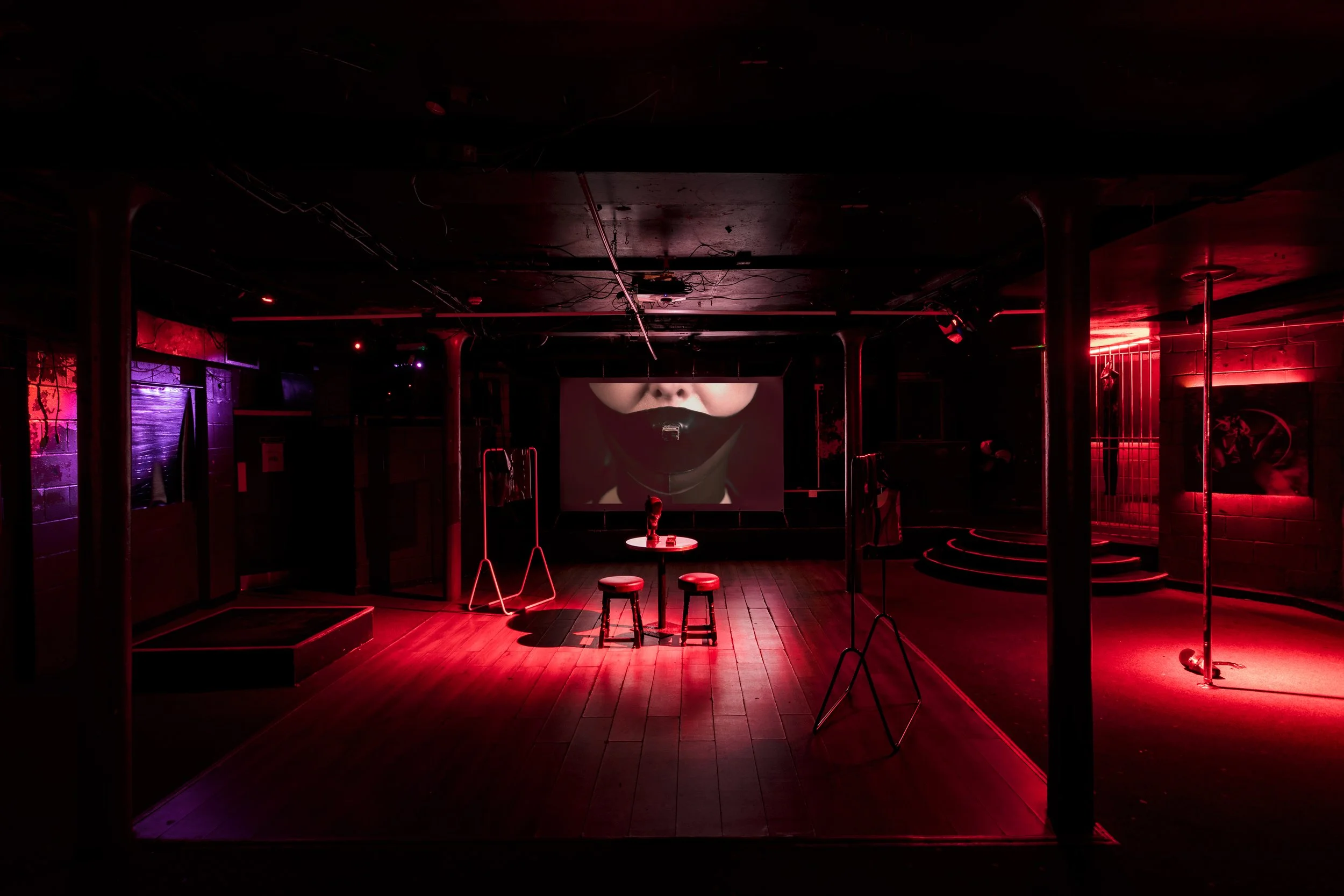
Entering Glasgow’s DIY-club and arts venue EXIT, I stepped into a cloakroom thick with incense smoke. Sitting behind a booth, an attendant scanned my ticket. Beside them laid a stack of cassette tapes, titled XTalk, by the artist group HommAges. Descending a steep flight of stairs, past a set of dilapidated toilet cubicles, I entered the venue’s basement. In it, a cluster of latex-adorned attendees crowded around a bar and leather banquettes, spilling loosely onto a dance floor built around a pole and a steel dancer’s cage.
It seems, at first, an unlikely setting for an exhibition, yet it’s entirely in keeping with a creative community like Glasgow’s, which has long relied on disused buildings, tenement flat exhibitions, and artist-led project spaces in the face of the city’s fraying cultural infrastructure.
Presented in the spring of 2026, HommAges exhibited their latest show, XTalk, within a former strip-club turned grassroots venue. Formed in 2018, the group comprises Craig Mulholland, Carmel O’Brien, Chao-Ying Betty Rao and MV Brown. Operating under a revolving directorship model, their work traces transgressive semiotics and non-normative sexualities within uncanny mise-en-scènes encompassing fashion, installation and performance.
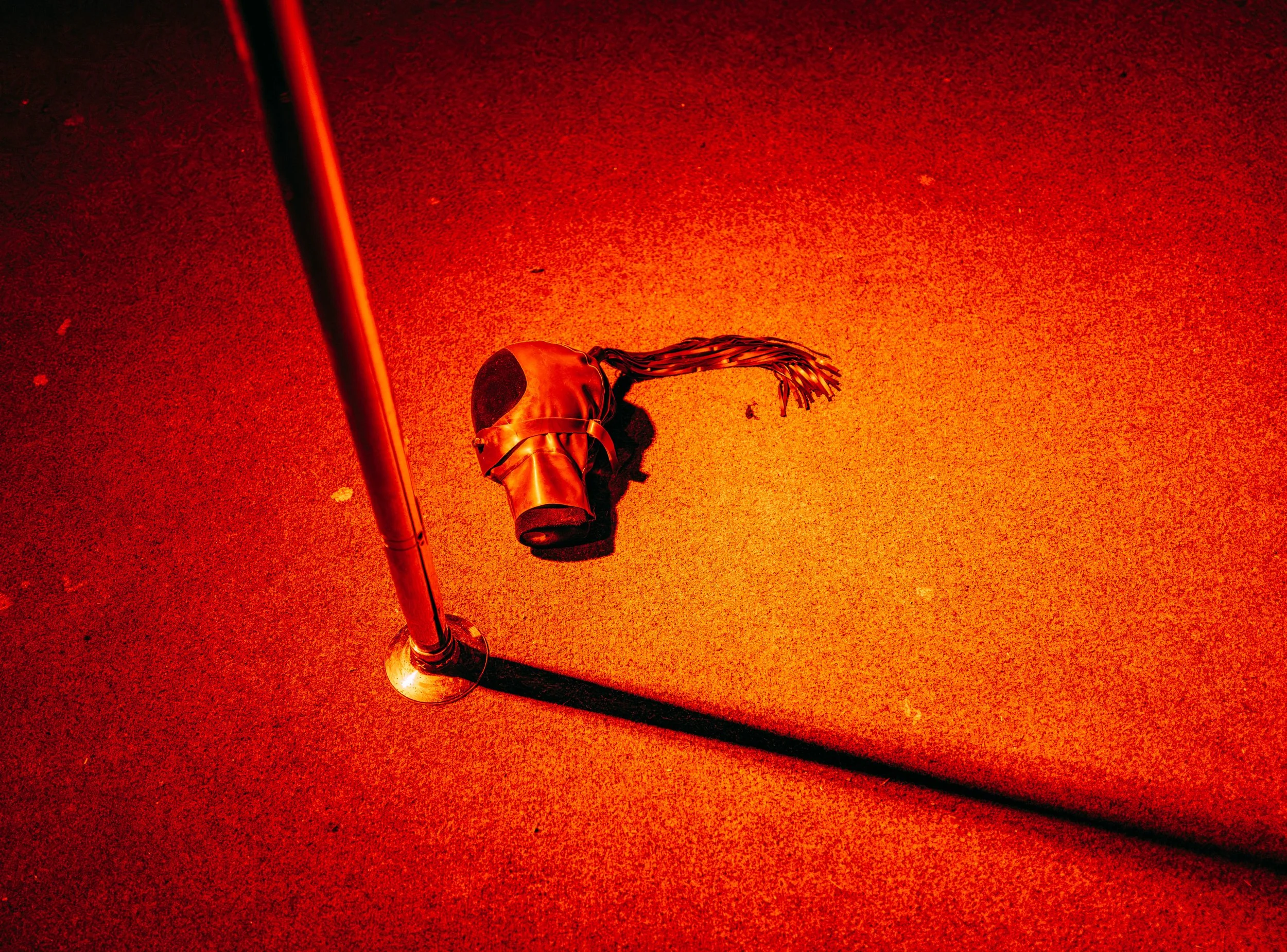
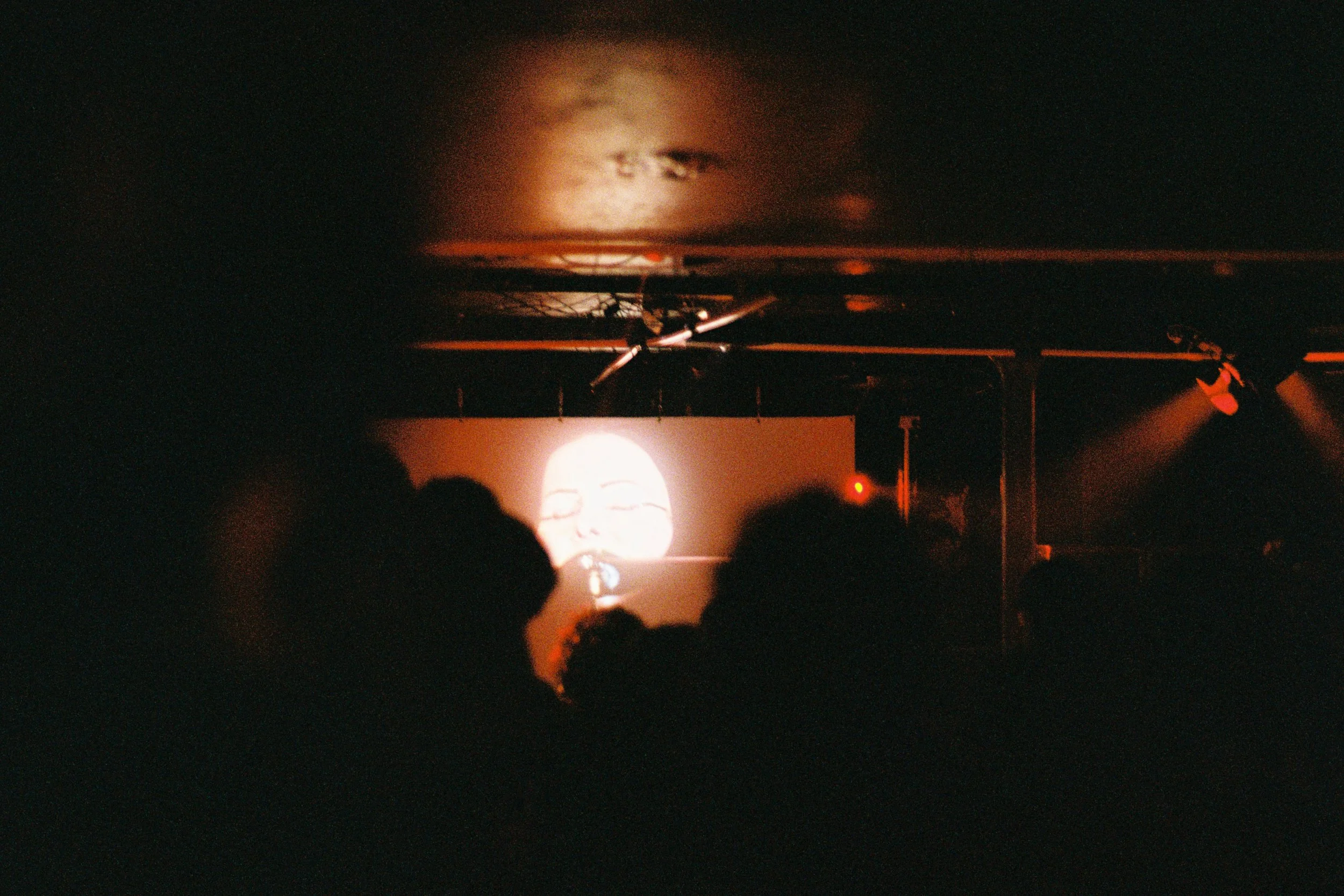
Commissioned by EXIT, the exhibition created a stage play of an erotic pop-up shop, with works nestled, hung and suspended in the space: a decapitated mannequin head with a ponytail, a collection of balloon-animal-shaped sex toys and a deflated latex dress hung from a hook. In the absence of actors, vestiges of labour could be found in handcrafted fabrics, appearing pulled, wrapped, bound and cast into sculptural garments or wearable artworks. At its centre was a new film, XTalk, reworking Dressing for Pleasure (1977), John Samson's seminal documentary on fetish enthusiasts in 1970s Britain, weaving its historical significance into a hauntological investigation of the artists' nostalgia for archival fetish media.
An accompanying cassette of the film’s soundtrack raised the generative potential of ‘crosstalk’ — the unintended signal bleed between analogue audio tracks — as a metonym for subcultural spaces and the ghosts lingering within fetish histories. Set against EXIT's own charged history as a former locale of sex work, the exhibition negotiated the role of objects and performance as sites of power, exchange and desire, and the limits of exploring these logics within traditional gallery settings.
For a group of institutionally recognised artists, their ambivalence about courting an art-world audience is most clearly exemplified by their unofficial manifesto pledge: the work can’t just be art, it must turn the viewer on. In adopting this tenet, the artists propose a new dimension to art’s ‘relational aesthetics’, one in which libidinal stimulation is not only permitted, but also actively encouraged.
I spoke with HommAges as they reflected on their collaborative process, nostalgia for fetish histories, and the limits of conventional exhibition formats in uncovering the affective potential of erotic art.
Courtesy of the artist, Photography by Lizzie Urquhart
Blair Wallace: Let’s start with your latest project XTalk which was exhibited earlier this year at EXIT. How did the exhibition originate and where did its ideas stem from?
Craig Mulholland: We were initially approached by EXIT to make a mix tape for the launch of the club’s record label, but we didn’t want to produce a tape that featured other people’s music. This initial idea became a way for me to think about the materiality of tape: how it enfolds in circular motions, its constrictive nature, how it behaves and often misbehaves. I remember buying cassettes as a kid – if you left them in the sun or didn’t look after them, the B-Side would play backwards on the A-Side, or the tracks would bleed into each other, resulting in an effect called crosstalk. It’s this strange and disorientating phenomenon that creates a weird intersectional space between tracks.
I presented these ideas to the group, the others started throwing things in and it all just went from there. We created a new film for the show which features Carmel and Betty posing in custom latex garments that Carmel made and the tape we created for the label that contains my soundtrack for the film. The whole edit is loosely based on John Samson's seminal work Dressing for Pleasure (1977) and is a kind of tongue-and-cheek take on product placement within soft porn. We wanted to create a more contemporary take on Samson’s work, but the camera work and gradient used in the film are completely reminiscent of TV films from that era. Linking back to my ideas around tape, I made the sound intentionally to echo that deterioration, as if a confessional ASMR sex-tape had been made in the 1970s.
I am interested in the idea of HommAges having a revolving directorship – and I guess I slightly directed this show. I like the idea that when one of us has a concept they’re interested in exploring, the rest of us fall into slightly more supporting roles.
BW: I’m interested in this notion of the group operating with a revolving directorship, insofar as one member’s idea shapes the way each of you attunes to a preconceived conceptual framework. Carmel, could you share how you responded to the concept Craig set?
Carmel O’Brien: Initially I was experimenting with thin translucent latex whilst making the garments that Betty and I ended up wearing in the film and our performance at the opening of the show. I was playing around and discovered that if you doubled up the latex at the seams it would make it appear much darker, almost appearing to mimic the look of tape.
CM: [Carmel] totally clocked that. In fact, Carmel had made some garments for Betty before for another performance, and at the time she said it looked like cassette tape. It was partly happenstance, but visually it was one of our crucial conceptual anchors.
CO: I also displayed two works from a previous solo show at Glasgow Project Room titled Privy Intimations. I was mainly working with liquid latex, and I started by laying down different textures, casting from these and then painting on top of them with more latex to build the garments – almost like a sculptor.
BW: It’s curious to hear you describe your garments as almost sculptural objects. Could you speak a bit about how you arrived at latex as a material, and what draws you to continue working with it?
CO: There is something incredibly satisfying about working with and transforming materials. I had this show at IOTA in Glasgow called Madame B; I worked primarily with craft paper, but I transformed it using different adhesives and finishes, so in the end it emulated the look and structure of leather clothing. It just happened that I used liquid latex during this process: casting different elements, putting down textures and applying it to different surfaces. I ended up with these amazing impressions that I had never seen before, and they were my textures, no one else’s.
BW: MV, could you speak a bit about your contributions to XTalk?
MV Brown: I exhibited two works in the show: a video and some sculptures. The video was a reworking of an older work of mine which was shot by my ex-partner. The video features me being wrapped and unwrapped in latex tape, as I turn around slowly like a mannequin on a turntable. I was a bit reluctant to show this work initially, because you can see my ex’s silhouette reflected in the tape, so I censored her by superimposing over the top a newer video performance I made of me moving to Craig’s tape soundtrack, using a Kinect sensor and effects in TouchDesigner.
The sculptures, Olisbos, were also older works which coincided originally as a kind of byproduct to a performance I did at Grace Exhibition Space, NYC in 2018. Dressed as a sad kinky clown in a male-mannequin-cast latex outfit by Carmel, I wore a ruff of long, phallic black balloons that I twisted into hermaphroditic genitalia. The work was inspired by the myth of Tiresias — the prophet transformed into a woman for seven years after striking mating snakes, experiencing pleasure across the gender binary. The sculptures were cast from those balloons in an homage to Jeff Koons; they carry an archival history of that live event, where the audience used headphones and binaural mics to hear the ASMR squeak of the rubber whilst I performed as if at a kid’s party for adults.
For XTalk, the club setting was perfect. I installed the sculptures along the bar and right outside the toilets, fittingly placing them where human connection and sexual activity are negotiated. I liked that these look like sex toys but are non-functional, in a "look but don’t touch" way. It's reminiscent of the voyeuristic pleasure of dressing up to go to a sex club or cruising space but not actively engaging in play.
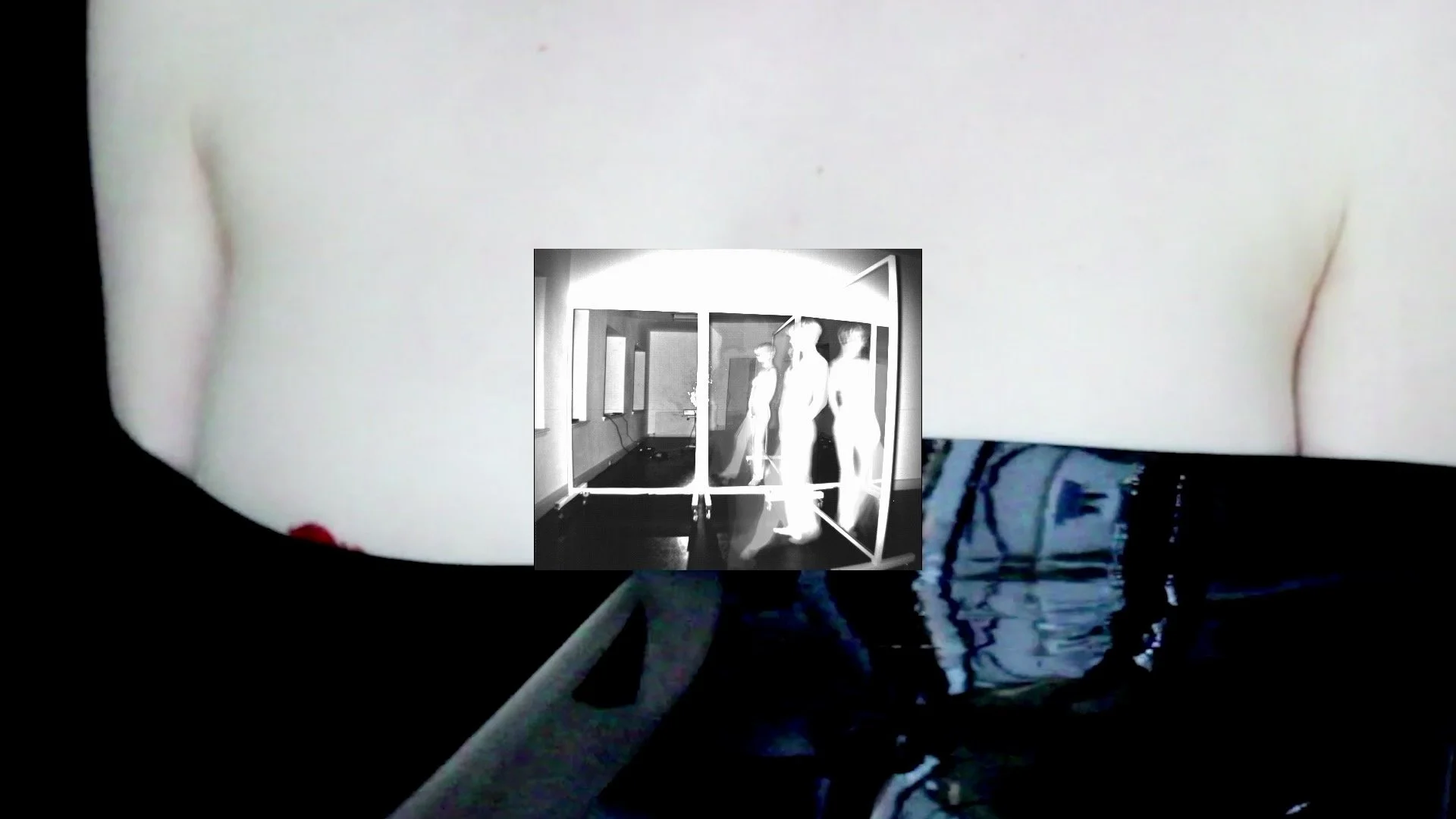
Still from XTalk, Courtesy of MV Brown
BW: Speaking of voyeurism, you've been thinking about objectification and being held in the gaze more broadly within your own practice. I’m thinking about your experience of life modelling and your role as a mannequin in previous HommAges projects. What role did these experiences have on your practice?
MV: My first real job was as a life model at the Glasgow School of Art, where I dreamed of going whilst I was studying elsewhere. I remember I always felt like a fly on the wall, privy to the exciting things the students were doing, whilst also being the object of their gaze whilst they painted from me. There was this tension between objectivity and subjectivity when it came to my body and self, and this is something I explored in my own performance works when I eventually studied there for my master’s, which is where I met Craig as my tutor.
I'm a shy individual but also somewhat of an exhibitionist, so I don't always feel in control of how much I reveal or conceal. I currently perform using a CGI avatar of myself built using 3D scans of my body, which acts as a kind of mask but has paradoxically allowed me to explore more vulnerability in my work. I feel like it's important as artists, and particularly those of us who use our selfhood as subject matter, to retain an element of mystery not only to keep people interested, but also to protect ourselves so that we control what we choose to share with our audiences.
BW: Staying on these notions of humour, live-ness and objectification, these are fundamental themes in Betty’s performance practice. I was wondering Betty, if you could speak to the transmission of these in the exhibition.
Chaoying Rao (Betty): When Craig described the concept to me, I was immediately drawn to the misbehaviour of tape: its circular, looping and doubling effects. The doubling is something that stuck with me, given our approach to the project was very, very space specific because EXIT has quite an unusual history. It used to be a strip club, and the crew there have maintained the black and red leather banquette booths and tacky interiors, even as they slowly fade away.
There are remnants of small, faded stickers of women on high stools and poles within the club that you can still notice if you look closely. It made me think about the tacky imagery usually displayed in strip clubs, imagery that has soaked up all the energy of the women who worked there before. That presence was definitely in my mind. Initially, I was unsure how to engage with the concept of crosstalk, but thinking about it now, it was a driver for us to unearth the ghosts that exist in our work.
CM: That makes me think about how tape never fully erases. You always get little artefacts from previous recordings. You can them on wave monitors, these ghosts on the track.
Betty: The space EXIT occupies has been through many changes — it was derelict for ten years. When it functioned as Legs & Co [the strip club], it only lasted four to six years. Before that it was another nightclub.
CM: It was Fury Murphy's — a kind of straight night-out club.
Betty: I feel spaces soak up a lot of energy. You can feel what they've been used for, and it reflects that energy back. Now it’s functioning as an artist-run space, it's this endless loop.
CM: It is almost like you went hall of mirrors on it.

Still from XTalk, Courtesy of the artist
BW: Craig, you spoke about responding to Dressing for Pleasure and the TV films from that era. I’m interested in the influence that this epoch has had on your practice, given the current prevalence of exhibitions exploring fetishism through a biographical or historical lens.
CM: I love the John Sampson films for two reasons: it documents fetishists who were active on the scene, and when I saw the film when I was younger, it genuinely turned me on. I discovered a sense of normalcy on my fetishism through these people’s lives.
Betty talked about the ghosts of former sex workers in EXIT. For me it's about vintage fetish magazines. There's something homemade about them. The only way I can intellectualise it is through hauntology — nostalgia for a time I wasn't even part of. Not through modern fetish work or what we make, but my longing for quaint vintage magazines like Atomage. I find them quite moving. Looking at these photographs of people in full latex outfits in their houses with net curtains and floral carpets, the work from that era seems to just subtly alter daily life. Its eroticism is almost quotidian and uncanny. My relationship with fetishism is like that. I don't have to be in a fetish club to feel fetishistic, though being there helps. Our work is less autobiographical. I like to think we’re queering the world, fetishising the world.
Betty: There's a certain vulnerability in those magazines of that era. I feel that way about architecture and spaces. They carry a weight that anchors you to what came before. Human memory is fallible, but a physical object can say yes, it happened, and I saw it too.
CM: John Sampson also made another film, The Skin Horse (1983) about disabled people's sex lives. It was very controversial at the time. I remember watching a patronising TV debate on it as a teenager, when I was just getting awareness of the scene, and I was horrified. The films are beautiful because they're made by enthusiasts. There's a tenderness there. That's the hauntology. I feel nostalgic for this time in the fetish community.
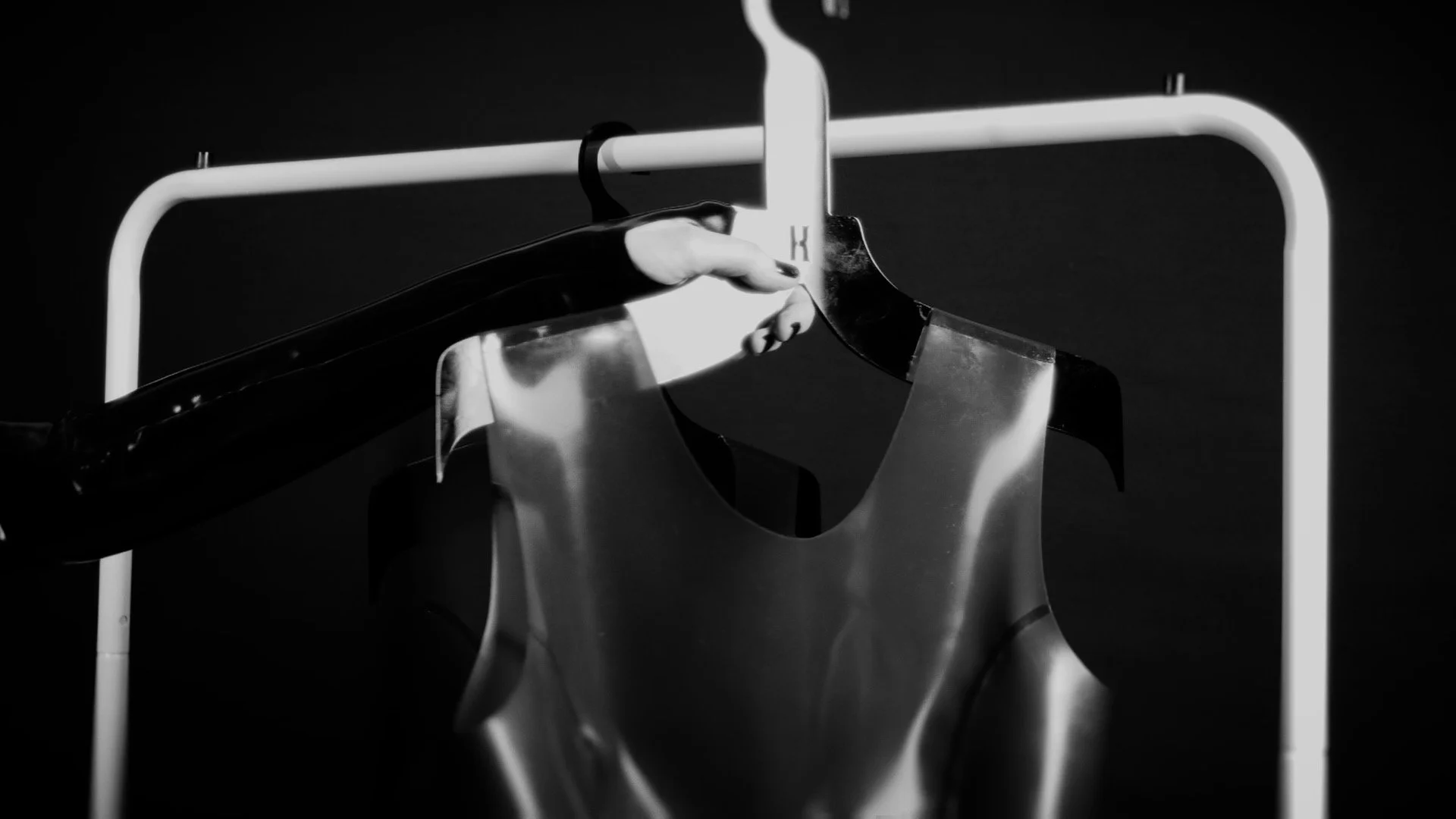
Still from XTalk, Courtesy of the artist
One of the fetish events Carmel and I have been going to for years, this group called Sealwear turned up — they’re one of the oldest fetish-wear companies. I couldn't believe they still existed. One of the owners is now in her seventies. They started making waders but they're still creating garments. These clothes have travelled through time, even though latex doesn't last. You rarely see it in museum collections because it deteriorates so fast. There's something about that transience we're interested in. Some of these objects and bodies will eventually only exist in images. It's that whole Barthes thing, that all photographs are a picture of death. Fetish garments are like that.
BW: Carmel, especially, your affinity with texture and material suggests that there’s a charge or power there that entices you.
CO: I will always say that putting latex on my body for the first time was one of the most liberating feelings I have ever experienced. Craig and I were getting ready for a fetish ball, and I put on a corseted latex skirt which was freezing to begin with, but it gradually warmed and moulded to my body. I remember looking in the mirror and being unable to recognise myself. I am not overly confident, but I felt like a different person. I felt amazing. I would never usually say that about myself.
Betty: It's a process of transformation.
CM: Carmel and I have talked about this. My sexuality is quite cerebral. I'm probably less physically sexual. I'm more into images and quite passive. Carmel is more into touch, and I'm more into the look. That must have some significance on our practice.
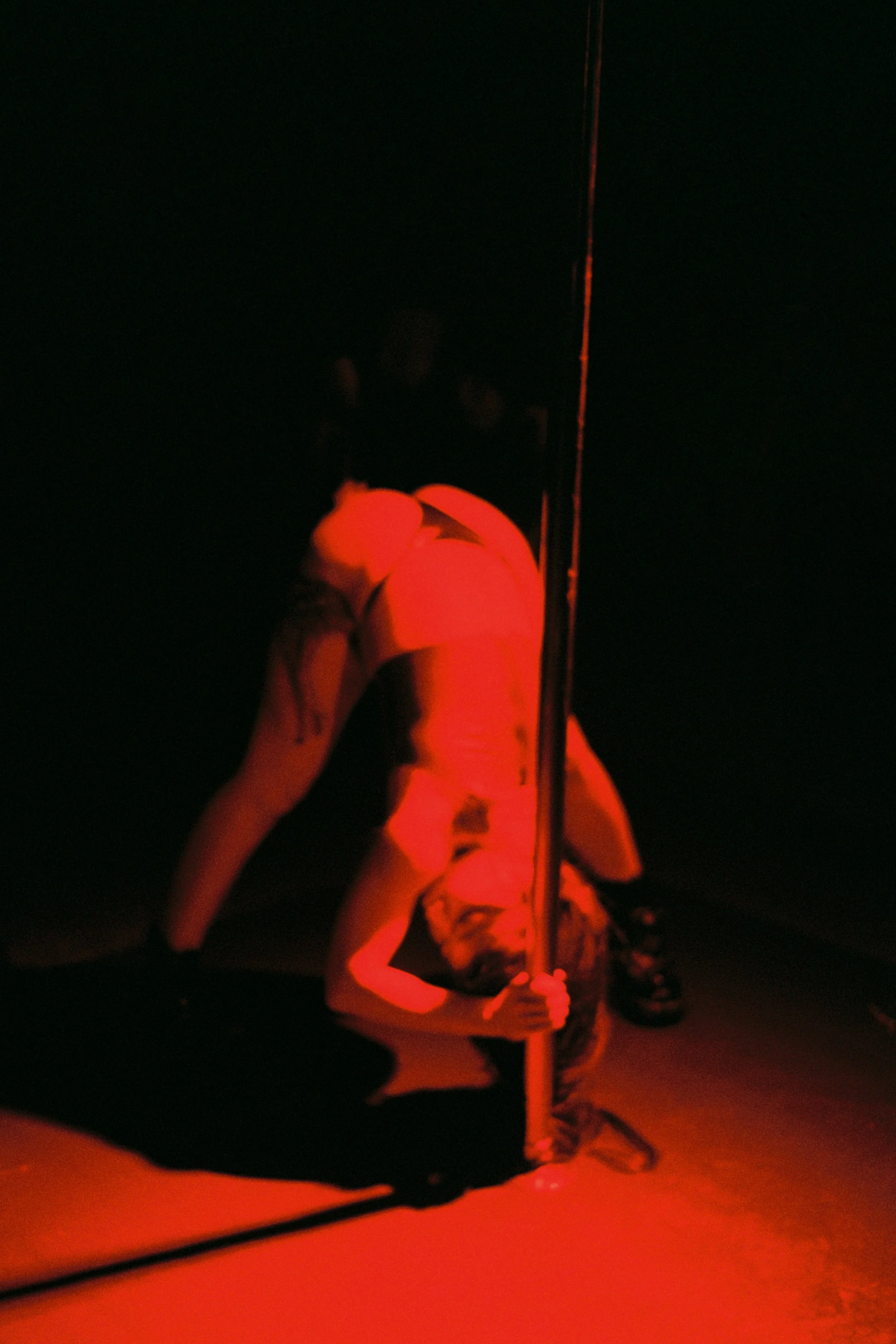
Betty: The way I approach it — you have the language of latex, the language of fetishism, the language of desire. I find it interesting that conversations on fetishism are almost always inherently very personal, whereas with other topics in visual art, you wouldn't expect that. Having worked in sex work for so long, I can easily separate the two. This is what allows me to use myself as another material, another medium. I am almost unfolding the mechanics of sex work.
CM: Is it almost like a painter who knows how a painting is made?
Betty: Exactly! I can enjoy this kind of work analytically and use those languages without overlap with my private life. Even if there is overlap, I'd contextualise it completely differently. That comes from doing sex work for so long.
CM: It’s funny as initially we didn’t want the projects to become too art-ified. We still want to speak to people who have fetish kinks, and we want the work to be sexy. It may have a foot in the white cube, but we'd feel we'd failed if we didn't turn people on.
BW: There was a bit of tongue-in-cheek commentary to be found on the in the exhibition; I’m thinking particularly about [MV’s] Koons-esque sculptures.
MV: Haha! I’ve always loved Jeff Koons, which I know isn't exactly a popular opinion amongst my peers. I even have two small balloon dog replicas on display in my flat. For me, it’s all about that seductive mix of high and low culture. His works are sexy, even if they explicitly appeal to capitalism. It comes down to a form of pure object fetishism; I find myself drawn to those ultra-shiny finishes and their apparent hollowness. They capture this vacuum of desire perfectly.
This link between power, money, and taboo desires reminds me of Reba Maybury and Lucy McKenzie's book Pervert or Detective? which looks at how artists can use the erotic and the transgressive to navigate these structures. In some ways, the work aims at queering Koons’ aesthetic from the inside out. Unlike his hollow, hyper-industrialised pieces, mine are a solid, low-cost production designed to shock or excite you back into the reality of a fluid, physical body.
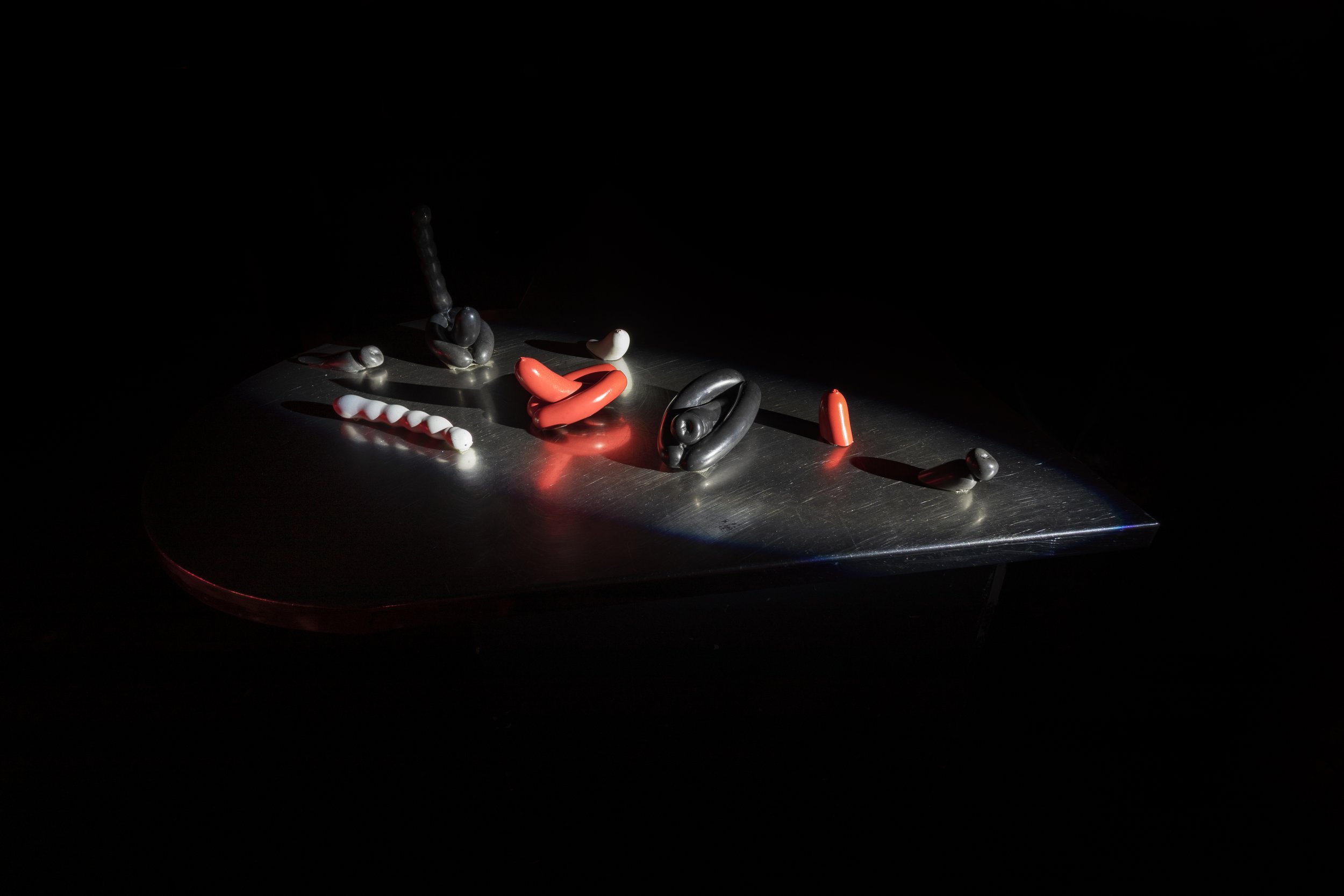
Courtesy of the artist, Photography by Patrick Jameson
BW: I find there to be an interesting paradox to be taken in refusing to lean too far towards an art crowd while also creating these charged objects that raise the potential of forming erotic bonds with viewers.
CM: I only intellectualise our work insofar as the whole idea of object-oriented ontology — the more left-wing side of it from Latour — where the sovereignty of the individual should be dispersed across objects, where the subject and object dichotomy is flattened. I guess that’s why I am into fetishism sexually but also culturally. As a submissive person, there is something incredibly liberating about becoming an object, it’s just wonderful.
Betty: When I started doing pole performances in art spaces versus sex-work-adjacent spaces, the response, atmosphere, and charge is always different, even though I'm doing the exact same thing. Experiencing that difference each time is fascinating.
BW: Fetish communities usually exist within subspaces that offer freedom through privacy, kinship and consent. I am wondering if placing XTalk out with a traditional gallery space offered the same gesture.
CM: The effect of being turned on by erotic work, and I'm being dogmatic here, but it's not that there's no erotic work in the white cube. It's almost seen as anti-intellectual. The power dynamics of society scare me because they're mostly hidden. When I'm in subspaces or the fetish world, people declare openly: this is my thing, my kink. It's not a fantasy world, but you can play safely with consent. Even dominant positions experience vulnerability because you must be open and consensual to explore it. You need to become vulnerable. The fetish scene allows me a subspace. I'd live in that subspace my whole life if I could, but society doesn't allow that.
Betty: Coming from the perspective of analysing and negotiating what's sexy and what's not and manipulating that through our work — I think the white cube is fundamentally unsexy. I think it's unsexy because it's a place of pretension. People engage socially in ways that call on their intelligence, social and cultural capital. It fosters a deep sense of insecurity from everyone involved, and insecurity doesn't foster vulnerability, which doesn't foster eroticism.
I've been thinking recently that if something exists in the world, someone is turned on by it. But I don't think anyone is turned on by the white cube.