
Why is everybody rebranding in 2026?
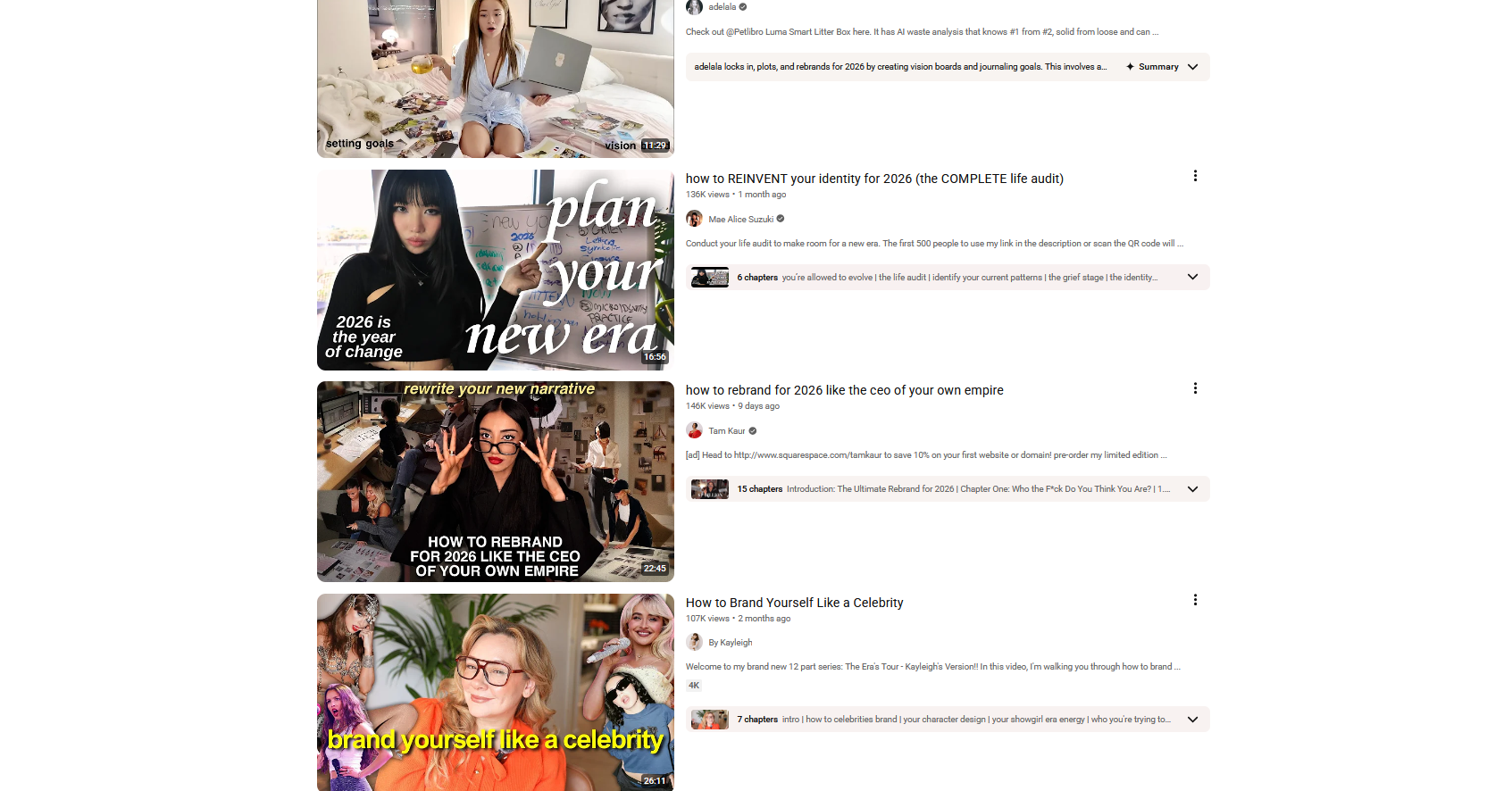
Youtube search results for ‘Rebrand 2026’
Everyone seems to be planning their big rebrand in 2026. Why? If we are all continuing to grow and develop within ourselves, should we not be seeking refinement in 2026, or are we all just considering 2025 a write off?
The timing matters. The fashion industry and beyond has spent the last few years in constant upheaval, but especially in 2025. The revolving door of fashion’s creative directors, CEO shifts, early 2000s brands making comebacks (hello comforting pre-fascist nostalgia), companies being bought and sold, logos gutted and rebranded with minimalist aesthetics, and more. It seems that everyone is feeling the pull towards something fresh and new.
The “2026 rebrand” is not a coincidence. It is the latest mutation of reset culture, self-optimisation content, and late-stage capitalist identity performance colliding in real time. By projecting transformation into the future, the present is conveniently skipped. The prevalence of rebrand content feels like a site-wide way of saying “I know something isn’t working” without having to say what or why.
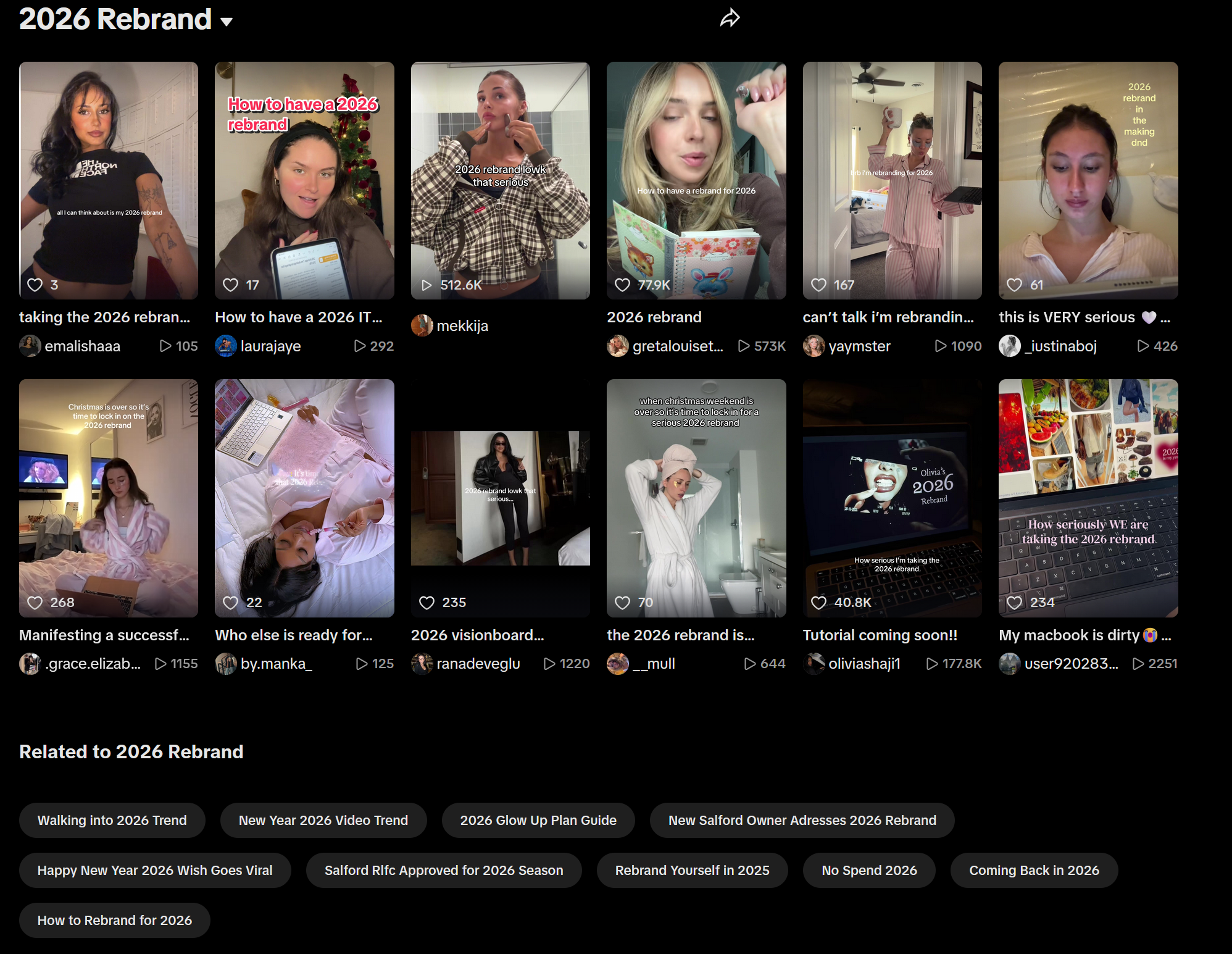
Tiktok results for ‘2026 rebrand’
The Self as Product
We have all become a little too comfortable with viewing ourselves as products and brands to begin with. While this trend might feel at home within a content creator’s vision board of ins and outs for the year, is this something we really need to pass down to every social media user?
This content beckons the viewer to question whether they are the best version of themselves, and one could argue that this is the engine behind capitalism itself. By borrowing language directly from marketing strategy such as pivot, era, rollout and positioning, we frame personal identity as a selling point rather than a lived fact.
In 2025, it became clear that institutions no longer offer continuity and that there is no safe or linear way to move through a career, especially in a cost of living crisis with record levels of unemployment. Politically, fascism is on the rise, and there is an active, ongoing genocide in more than one place in the world. Should we find it troubling that instead of looking inward at what we can do for our communities, we are being prompted to re-aestheticise our grids?
To view this with more nuance, asset insecurity is clearly a major driver. When people feel unable to rely on stable income, housing, or futures, aesthetic and editorial control becomes the last remaining domain of agency. The self becomes the only “asset” people feel they can manage.
Rebranding yourself is sold as empowerment, as though you are taking the future into your own hands, but it mirrors the same logic that turns workers into personal portfolios and lives into monetisable narratives. Fortune favours the bold, and this trend promises that if you vision board hard enough, you might win.
When we cannot control rent, safety, political outcomes, or even financial reliability, the things we can control such as appearance, output and narrative become paramount in our pursuit of self-comfort. Just as in recessions, the lipstick index rises. This, alongside pre-existing “little treat culture”, functions as a creature comfort in deeply unpredictable times. It becomes a stand-in for structural power people do not believe they possess.
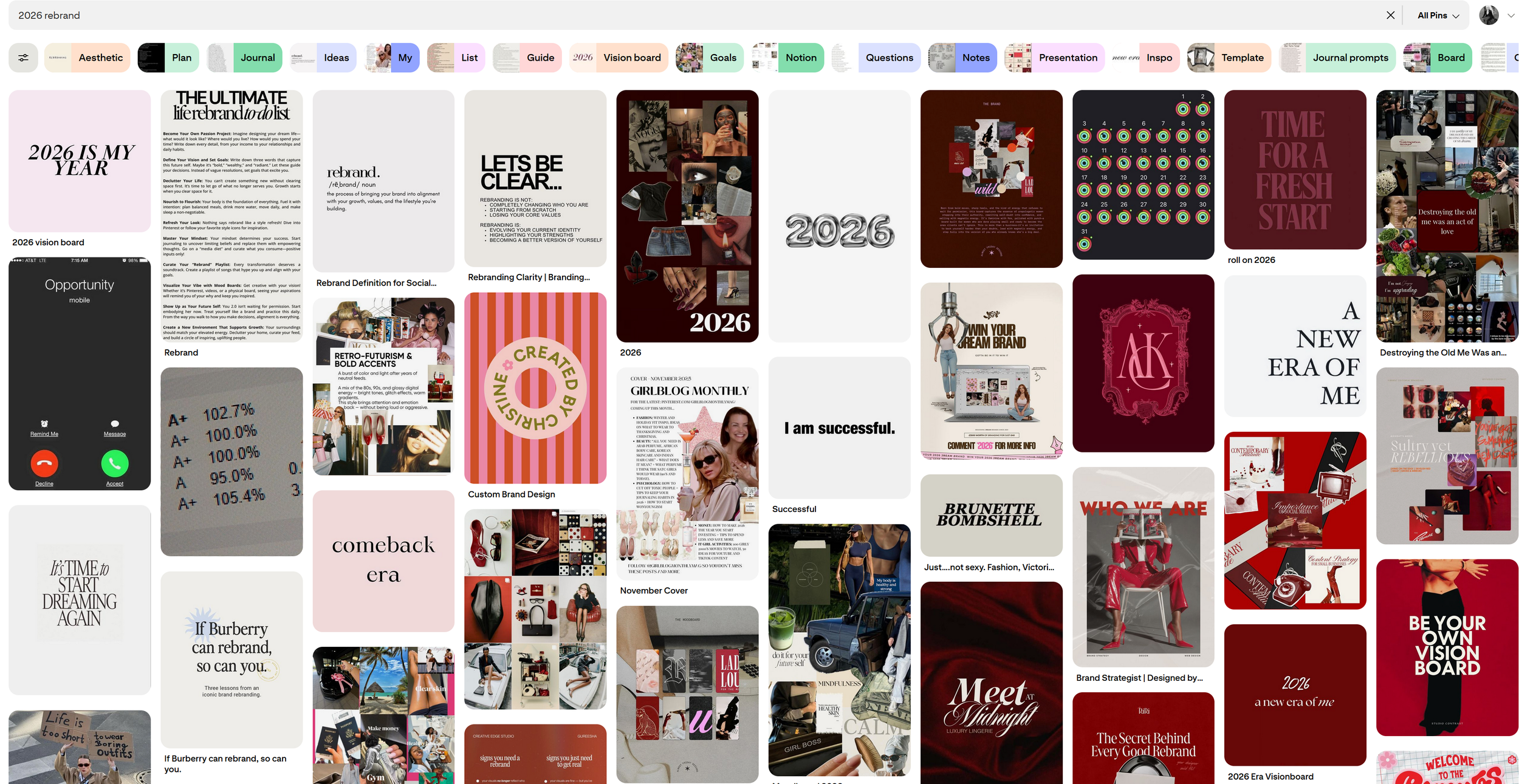
Pinterest results for ‘2026 rebrand’
Self-Study, Offline Living, and the Performance Trap
2025 saw the rise of trends that appear set to continue through 2026: self-study curricula, offline living as a wealth indicator, slow growth, slow living, and detachment from the algorithm. At the same time, people are discussing the death of personal style. Yet while these ideas are relentlessly documented, aestheticised, and broadcast online, we remain deeply committed to the behaviours that keep us trapped within performance culture. When rest becomes content, privacy only holds value if it is visible. Otherwise, we are operating at a perceived financial or cultural loss. If being offline is the ultimate flex, why is it being rehearsed so publicly?
The Myth of Coherence
Rebrand culture promises clarity, as though fragmentation were a design flaw rather than the condition itself. No amount of visual consistency can resolve precarity, contradiction, or the grief inherent to life.
The human condition craves development, evolution, and growth. With that in mind, perhaps instead of a total 2026 rebrand, we should be opting for a 2026 refinement.
You were doing well the entire time. Anyone still alive and doing their best in this economy is doing incredibly. So why not refine the good parts?
What brought you joy in 2025?
What comforted you outside of purchasing objects?
What got you out of bed in the morning and sent you to sleep at night?
Can you cultivate more of that in 2026?
As individualist as society has become, it has also taught us to miss the point. Long-term comfort is built through community and collective action, not endless self-reinvention. If you are panicking about collapsing ecosystems or ongoing genocide, remember that action is the antidote to despair.