
One Wish: To Be With My Wife - by Mischa Gore
Words: Mischa Gore
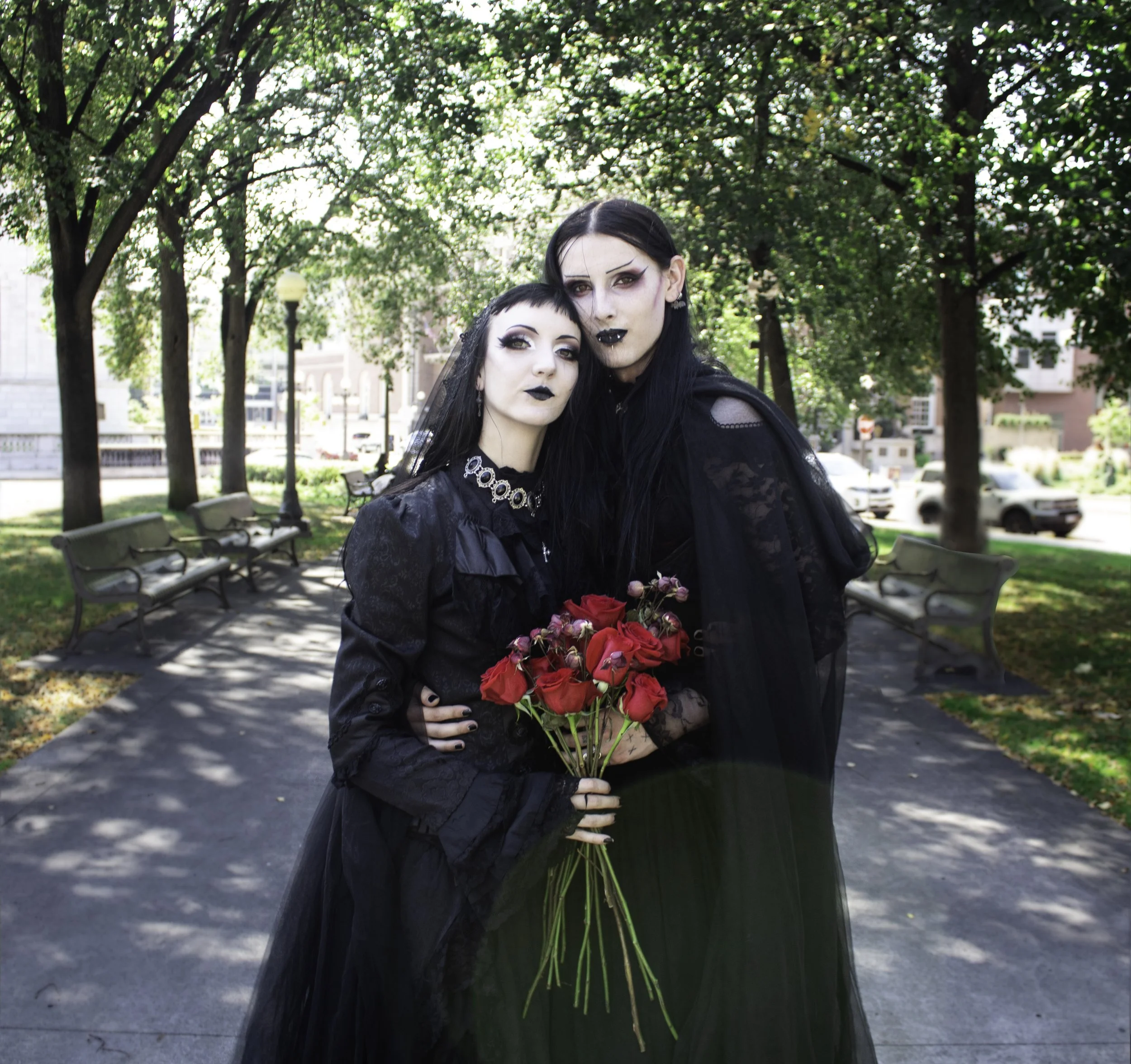
My name is Mischa Gore. I live in Minnesota, in the United States. My wife, Monstera Gore, lives in Aberdeen, Scotland. We are separated by roughly 3,732 miles and an immigration system that has made building a life together far more complicated than falling in love.
In 2024, Monstera crossed that distance so we could get married. We spent six beautiful months together in the United States, beginning our marriage with the ordinary intimacies that make a relationship feel like a life: waking up beside each other, cooking together, planning adventures, cuddling while watching her favorite movies, making love, falling asleep with her in my arms and imagining a future that no longer required counting the days until we could meet again.
After our wedding, we began the process of applying for a UK marriage visa so that I could move to Scotland and we could finally establish our home together. Our application was refused because we did not meet the financial requirements. Our relationship was not the problem. Our ability to satisfy the system's requirements was.
There is something profoundly disorienting about being legally married to someone while being unable to live with them. The government recognises the relationship in one sense, yet its rules determine whether we can experience marriage in the way most people take for granted. Our future depends not simply on our commitment to each other, but on money, paperwork, eligibility criteria, waiting periods, and decisions made by people who have never met us. Intimacy becomes an administrative problem. Love must be documented, measured, and made legible to institutions. Our private life becomes a case to be assessed.
This is the reality behind One Wish Obsession, my entry in the 2026 Face of Halloween competition. The project began with a question inspired when I watched the 2025 horror film Obsession by Curry Barker: what would happen if I had access to a One Wish Willow and could wish for anything in the world? My answer was immediate. I would wish to be with my wife.
I wanted to turn the emotional reality of our separation into something viewers could encounter visually, not simply read about and sympathise with, but feel in their hearts. I hoped it would hold the desperation, the fixation, the claustrophobia of waiting, and the strange unreality of a life in which the person you love most is always present and absent at the same time.
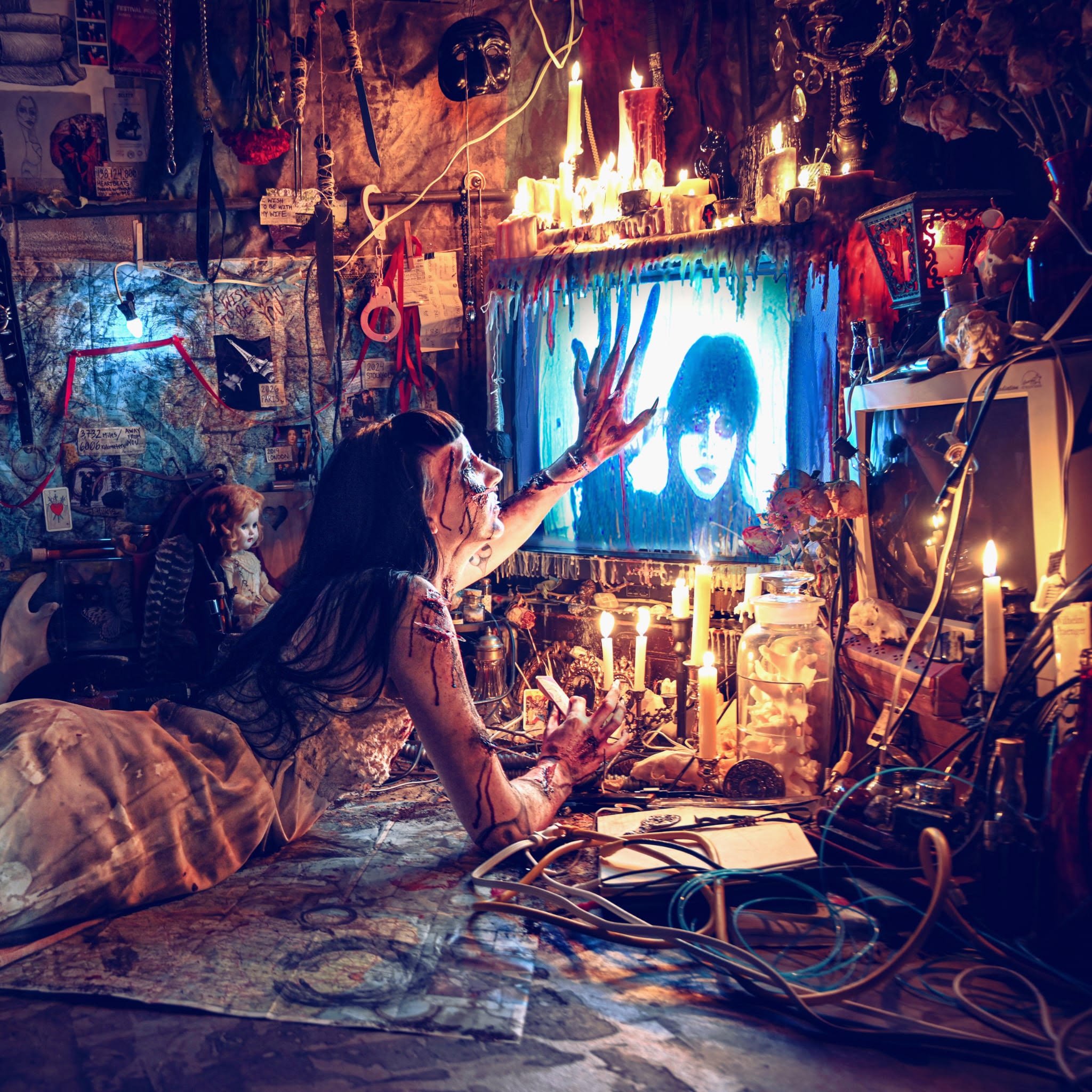
To achieve what I visualized in my mind for the main image, I placed myself on the floor before an old Mitsubishi CRT television, hundreds of candles used to create the waxy altar dripping from it. On the screen is Monstera, appearing in the grainy, distorted language of surveillance footage, standing in an empty white hallway. Her hand presses against the glass. Mine reaches toward it.
The television is both a connection and a barrier. It allows me to see her, but it cannot give me her touch or her warmth. The image makes visible a condition that has become ordinary in our marriage: looking at each other through screens, trying to make a digital presence stand in for physical closeness. The surveillance-like perspective is deliberate. Our relationship exists under the gaze of a system that demands evidence, documentation, and proof. The image asks what it means when something as intimate as marriage becomes subject to institutional scrutiny.
Around the television, I built an obsession wall from photographs, stained maps, lithography prints and drawings I've made of Monstera over the years. I hoped it would show what separation can do: the absent person occupies every available space. You build your days around them. You collect images, plan routes, calculate costs, and search for ways forward. Hope becomes a ritual, and repetition becomes its own kind of obsession.
The set was created through hands on experimentation and a mixture of odd objects from my own collection of home decor: a real human skull, a porcelain doll I rescued from a burning building, animal bones I harvest and process myself, A mask I purchased in Naples Italy, and of course a wide selection of our BDSM gear. The more you look the more oddities you will find within the image. I wanted the environment to feel accumulated rather than pristine, as though longing had been building there for a long time. The CRT, the cables, the photographs, and the maps all belong to the same emotional landscape: a private altar to someone I cannot reach.
The image was also made possible through the creativity and skill of my local team. My friend Olivia Olson spent six hours creating the special effects makeup, developing the look that brings the horror of the concept onto the body. Her most ingenious contribution was the idea to use broken CDs to create glass like prosthetics. The final photograph was shot by my friend Jes Salazar, a professional photographer, whose work captured the carefully constructed atmosphere and visual tension of the scene. Together, their contributions helped transform the concept from an idea in my mind into a tangible, cinematic image.
The work is theatrical, but the circumstances behind it are not. I am not trying to suggest that immigration rules are supernatural evil or that every border decision has the same consequences. I am interested in the gap between the abstract language of policy and the intimate realities it governs. A financial threshold may appear neutral on paper. In a marriage, it can mean another year apart, another set of expenses, another period of living without the ordinary physical presence of the person who makes a place feel like home. For Monstera especially, I am the only home and safe space she has ever known. To be denied that security for years, is unimaginably painful.
For queer couples, these questions sit within a longer history of institutions deciding which relationships deserve recognition, protection, or a place in public life. Legal recognition matters, but recognition alone does not guarantee the material conditions needed to live together. Being married does not make a border disappear.
Monstera has built a life in Aberdeen through her creative and queer communities. She organises Gore, Aberdeens only kink event, and Eclipse, an alternative LGBTQ+ night, and she DJs for Torture Garden events across the UK. These are not peripheral details to our story. They are part of the life I want to share: the people, spaces, and creative communities that make a place meaningful. Moving to Scotland is not simply about crossing a border. It is about joining my wife in the world she has made.
I entered Face of Halloween because I wanted to turn this real life nightmare into art, but also because the competition offers a potential way forward. The prize is $13,000/9,794£ which could help cover the costs of our future marriage visa application and bring us closer to living together. The competition also supports Starlight Children's Foundation, which works to bring happiness and comfort to hospitalised children and their families.
I know a competition cannot resolve the structural problems that keep families apart. Nor should the burden of overcoming those problems fall on strangers voting for an artist online. But art can make an invisible experience visible. It can give people an image to recall when the language of policy makes suffering sound impersonal.
One Wish Obsession is built around one wish, but the work is ultimately about connection: the hand against the glass, the body that is missing, the distance that becomes tangible precisely because it cannot be crossed. Physical touch is how we reassure ourselves that another person is here. It is how a relationship occupies the world beyond words and screens. When access to that intimacy is restricted by institutions, separation becomes more than a matter of geography.
I wish to move to Aberdeen. I wish to live with my wife, share our daily lives, and stop treating physical closeness as something that must be scheduled, financed, and approved. Until then, I am making art out of the distance.
My entry in the Face of Halloween competition is called One Wish Obsession. If this story resonates with you, you can find my profile and cast your vote at faceofhalloween.org/2026/mischa-gore
The competition has several elimination rounds, and votes reset at the start of each round. You can cast one free vote every 24 hours, so daily votes really help us. The goal is to make it through each round and ultimately win the competition. The final round of voting closes on December 17th and the winner is announced January 14th.
Follow our story and get more behind the scenes details on Instagram @one_wish_obsession
Every vote helps me advance toward the prize that could help bring us closer to home.
One wish. One obsession. To Be With My Wife.