
Cinema as Moral Testing Ground: Interview with ‘think of england’ director Richard Hawkins

Cinema has always been entangled with the politics of what can and cannot be shown. Across its history, the medium has repeatedly collided with shifting ideas about decency, censorship and the limits of representation, testing how far audiences are willing to follow an image once it begins to cross moral lines.
At Féroce Magazine, we are drawn to cultural work that interrogates the power structures behind images rather than simply reproducing them. Think of England operates in that space, using wartime myth as a lens through which to examine censorship, the politics of sexuality, and the uneasy relationship between morality and moving images.
Ahead of the film’s screenings at the Glasgow Film Festival and Manchester Film Festival, we spoke with writer and director Richard Hawkins about the strange folklore that inspired the film, the history of cinematic censorship, and why the boundaries of representation remain as unstable as ever.
How do you believe cinema has repeatedly been used to push at the edges of what society claims to tolerate, and how does Think of England explore this?
Nothing has chronicled the evolution of what is and is not considered acceptable taste and decency quite like the history of the motion picture. From a blurred and distant Hedy Lamarr walking naked through the forest, Clark Gable suddenly not giving a damn, to Burt Lancaster properly snogging Deborah Kerr as the foaming surf breaks over the pair of them, all in their time taboo-shattering. The gradual pushing back against any perceived boundaries has been like one single, drawn-out striptease.
All attempts at constraining such perceived slippage, championed most famously by the Hays Code (1930–68), have ultimately proved little more than new artistic challenges. Think of England is an attempt to encapsulate this whole journey, the entire history of film in fact, and its insatiable striving for perfect realism, in a single three-day mission on a remote Scottish island in the Second World War.
By placing a group of actors and filmmakers in a situation where the boundaries of what they are willing to perform are constantly being tested, the film mirrors cinema’s long history of pushing against what audiences consider acceptable.

Cast Ensemble - Think of England - Photo Credit - Vianney Le Caer
Cinema’s all-consuming nature allows audiences to be absorbed into a story, temporarily inhabiting moral positions they might otherwise reject. In what ways does Think of England draw in the viewer and hold that moral compass for them?
It was really important to me that, with the possible exception of Clifford, there were absolutely no goodies and no baddies in Think of England. That, to my mind, would be a failure of character depth and richness. What mattered was to progressively reveal quite how compromised each character truly was, and quite how profoundly all innocence had been lost.
Given that this is a film about acting, and that acting is to a large degree the act of inhabiting other perspectives and attitudes, hopefully it would thereby be possible for our audience to experience, almost vicariously, positions they would never ordinarily allow themselves even to countenance. In doing so, they might find a sympathy that would probably otherwise escape them. Everyone, even the very worst, deserves to be understood.
I also wanted the toll of acting to be recognised as a condition, and I mean not only for the professional actor at work but all the rest of us too, desperately and permanently rewriting a better, more convenient version of ourselves.
Cinematic absorption can create perspective, invite empathy and self-interrogation. How does the film challenge viewers’ perspectives?
When the script was out there doing its rounds, I found it constantly surprising that the single element that seemed to cause by far the most offence was Agnes performing a sexual act on Tyrone Higgs in front of her son.
Here was a mother willing to do absolutely anything to keep her own innocent flesh and blood from the disgusting awfulness of the bloodbath that otherwise awaited him. A mother simply demonstrating the immeasurable degree of maternal love. And this, bear in mind, in a film that includes depictions of rape, murder, the Holocaust, you name it. But no, it was that one act that was deemed truly beyond the pale.
I realised then the film was always structured around such moral equivalency and that I needed to embrace this at every opportunity. In doing so, hopefully our audience would, little by little, be drawn onto this uncomfortable and confusing vantage point, whereupon they suddenly see the blacks and whites we generally and complacently live by in a whole new grey light.
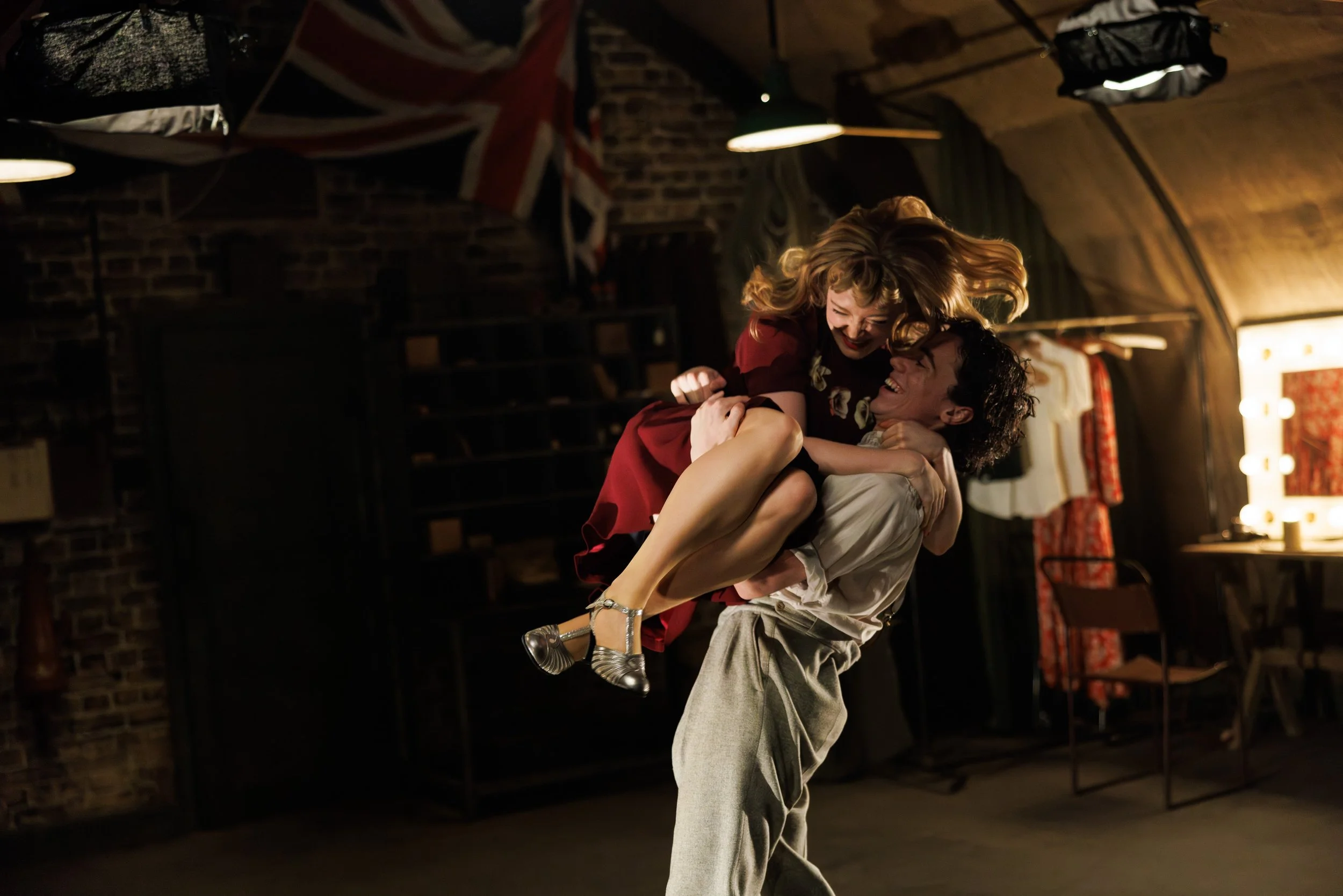
Natalie Quarry and Ollie Madigan -Think of England - Photo Credit - Vianney Le Caer
Stories about wartime expose these contradictions with particular clarity. How did you research and prepare for the film, and how does it honour historical truth?
I have always been more than a little obsessed by the Second World War, and that’s from a very young age. It encapsulated a moment in history where literally everyone suddenly had no choice but to stop whatever they were doing and recalibrate their entire existence. So many people had, overnight, to method-act themselves into brand-new and almost unrecognisable iterations of their former selves, starting for most simply by putting on a different costume and taking it from there, to witness sights and be asked to do what would previously have been unconscionable.
War stresses society’s moral codes like nothing else. Hence the almost symbiotic correlation between war and morality and acting and drama and film and sex and so on.
I should also say that I wrote Think of England during the pandemic, probably the most comparable moment to the early 40s that any of us have experienced.
With regard to the film’s historical veracity, we really did go to every length we reasonably could. Whether that was the subtle undoing of seventy years of spoken English evolution, the forensic dressing and undressing of our characters and their surroundings, keeping our black and white in classic 4:3 (hence the offsetting choice to shoot the colour in 1:66), recording its sound on original 1940s horsehair microphones, lighting the whole thing in hard tungsten, and so on.
A period drama like this really does need only the slightest misstep for the whole illusion to crumble.
The film sits in a moment where politics are regressing and conservatism is on the rise. What does that say to you about censorship and policing of sexuality in practice?
This is an even more unusual moment than I think most people have quite grasped. The whole world seems to be veering so horribly to the right, with democracy and its abiding values in such obvious retreat. Which would suggest that society is once again marching to an increasingly conservative beat.
And yet, for the first time that I can think of, so much of the artistic censorship, or at least the censoriousness, seems suddenly to be coming from the previously liberal left. Those who historically have always championed complete artistic freedom as a linchpin of an open and confident culture.
It is a curious paradox that is hard to explain. So much of all that’s been unhelpfully lumped together under the banner of what is often called ‘woke’ (as it happens now used almost exclusively derogatorily) has been unquestionably valid, welcome and long overdue. But it is still a form of censorship or interference, and any censorship will always be dangerously subjective.
Interestingly, Think of England, I now realise, could be argued to pinpoint the very moment that intimacy coordination first became a concept. Actors articulating the emotional consequences of being asked to do what clearly would make them uncomfortable and then talking it through.
It was part of a genuine attempt to get all these opposing and very contemporary socio-political tensions into a single melting pot and then see what happens. It just seemed more resonant to set the whole thing back in the period when the world last took such a lurch to the right and into the arms of autocracy, and dare we say it, fascism.
And just look what happened then.
I truly hope the film somehow successfully encapsulates these paradoxes at work, how each of them informs the other, and that ultimately it speaks as a cautionary tale for all parties.
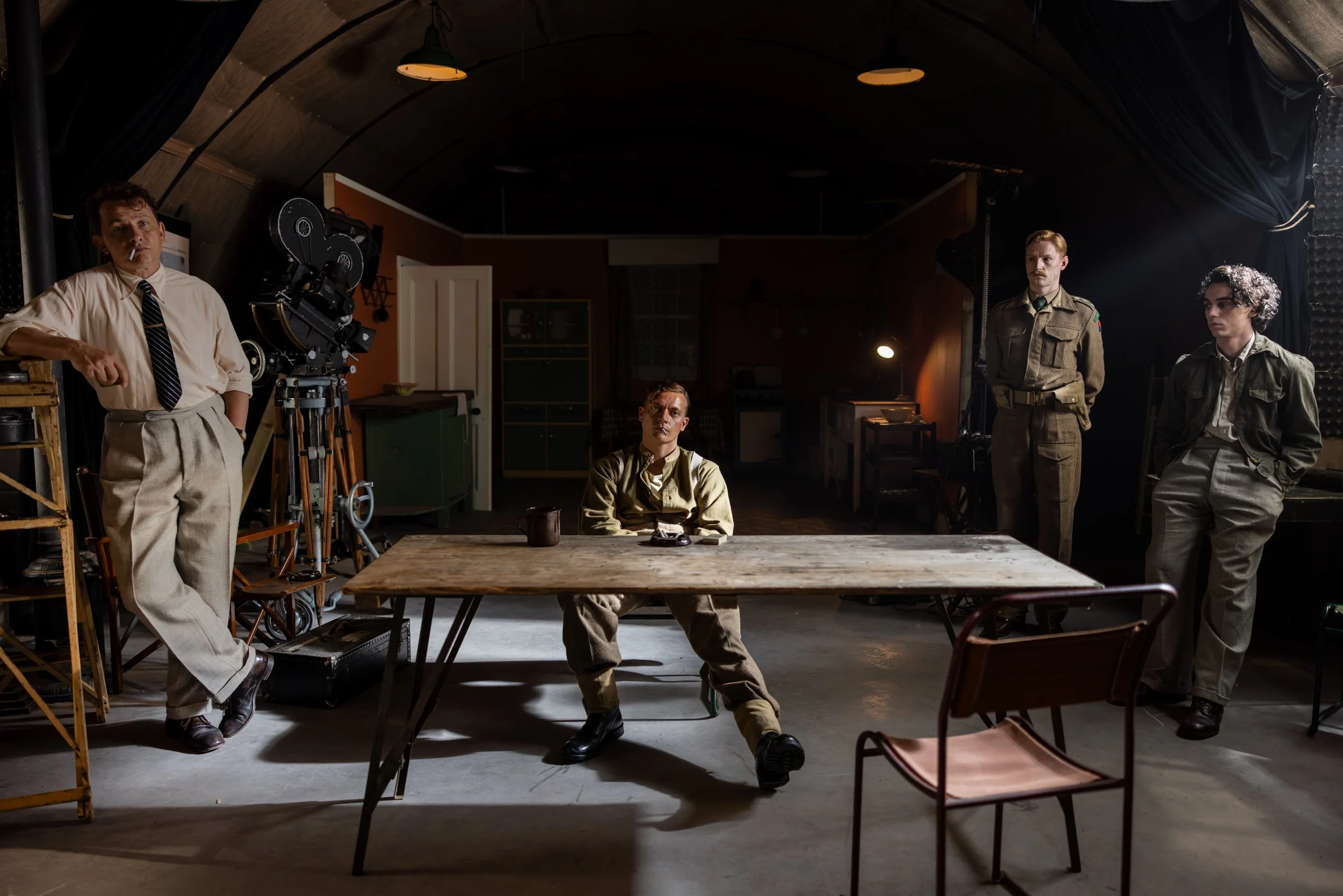
Male Ensemble - Think of England - Photo Credit - Vianney Le Caer
Historically, cinema has often been policed in the name of public decency. Do you think that instinct has really changed, or just taken different forms?
In exploring the themes of Think of England I became fascinated by where the ultimate, definitive boundaries of acceptable public decency lie, particularly with regard to film. Are there any taboos that simply can never be crossed?
It was this idea that became the compass by which I navigated the entire story. For a film to be considered credible drama, two taboos would likely always remain: actually having sex, and actually killing. And yes, we all know that the first of those has been challenged and explored almost, but not quite, exhaustively.
Even so, if one really thinks about it, neither of those two can actually be acted when it is being done for real. You can kiss for real and still be acting. Fight for real. Do almost everything for real and still only ever be acting. But you cannot act having sex, just as you cannot act killing. More importantly, because the experience of doing it could never be anything other than real.
Likewise killing. Even if someone were to volunteer of their own volition to be killed for real on camera, all in the cause of utterly convincing drama, neither that individual’s experience of the scene nor that of whoever was charged with committing this murder could ever be considered just acting. They would both have done it for real and would now suffer the consequences, even if not legally then certainly psychologically and emotionally, and not just until the director calls cut but forever.
This, I realised, is where all non-political censorship is derived. Work back from this extremity until a reasonable and workable point can be found. That was the starting point for Think of England, our attempt to find a natural, rational and reasonable outer boundary.
I can now confidently report that it remains as clear as mud. Or perhaps sand would make for a better analogy, with those moral and ethical lines we insist on drawing constantly being washed away with every new tide.
War films often simplify morality into heroes and villains. What did you want to resist about that tradition in Think of England?
Almost always a war film favours the perspective of one side over the other, generally favouring the good guys not because they are intrinsically any better, but simply because they are the ones we care about more. Their deaths are traumatic, their deeds heroic. The other side becomes storytelling’s collateral damage.
With Think of England, the human experiment that it is, it was very important that this disparate band of pornographers, our petri dish, was made up of both sides, both genders and all persuasions.
So yes, it is a war film, but up until the very end that warfare is almost entirely psychological. To have both sides of the conflict now working together in such a heightened way on such a bizarre collaboration simply had too much potential not to explore.
There are films in which both sides of an otherwise military conflict play a football match or something instead of fighting. I am fairly certain this is the first time they have tried making some porn together.
You’ve made a film about the moral dangers and power of images using that same medium. Did that create any tensions or doubts for you during the process?
I really do not like the word, but the making of Think of England so often became almost overwhelmingly meta.
A film about the toll on actors being asked to do what would clearly make them uncomfortable, played by actual actors being asked to go further than they had before.
A film about actors wanting to talk through how they feel about doing whatever is now being asked of them, whilst those same actors actually playing these parts discuss their own emotional whereabouts with the on-set intimacy coordinator.
Actors portraying a film crew under such stress and duress as they attempt to work in almost impossible conditions to complete an absurd filmic mission, being filmed by a real film crew working under pretty much equally impossible conditions to make an utterly unexplainable film.
So often the actors seemed to be speaking for the crew as much as the cameras.
Tension and doubt were certainly a significant presence within our working dynamic. But excitement too. The excitement of proceeding in a way none of us had ever worked before, heading towards a destination none of us could even quite picture.
And did I say terror? Definitely a whole chunk of that too.
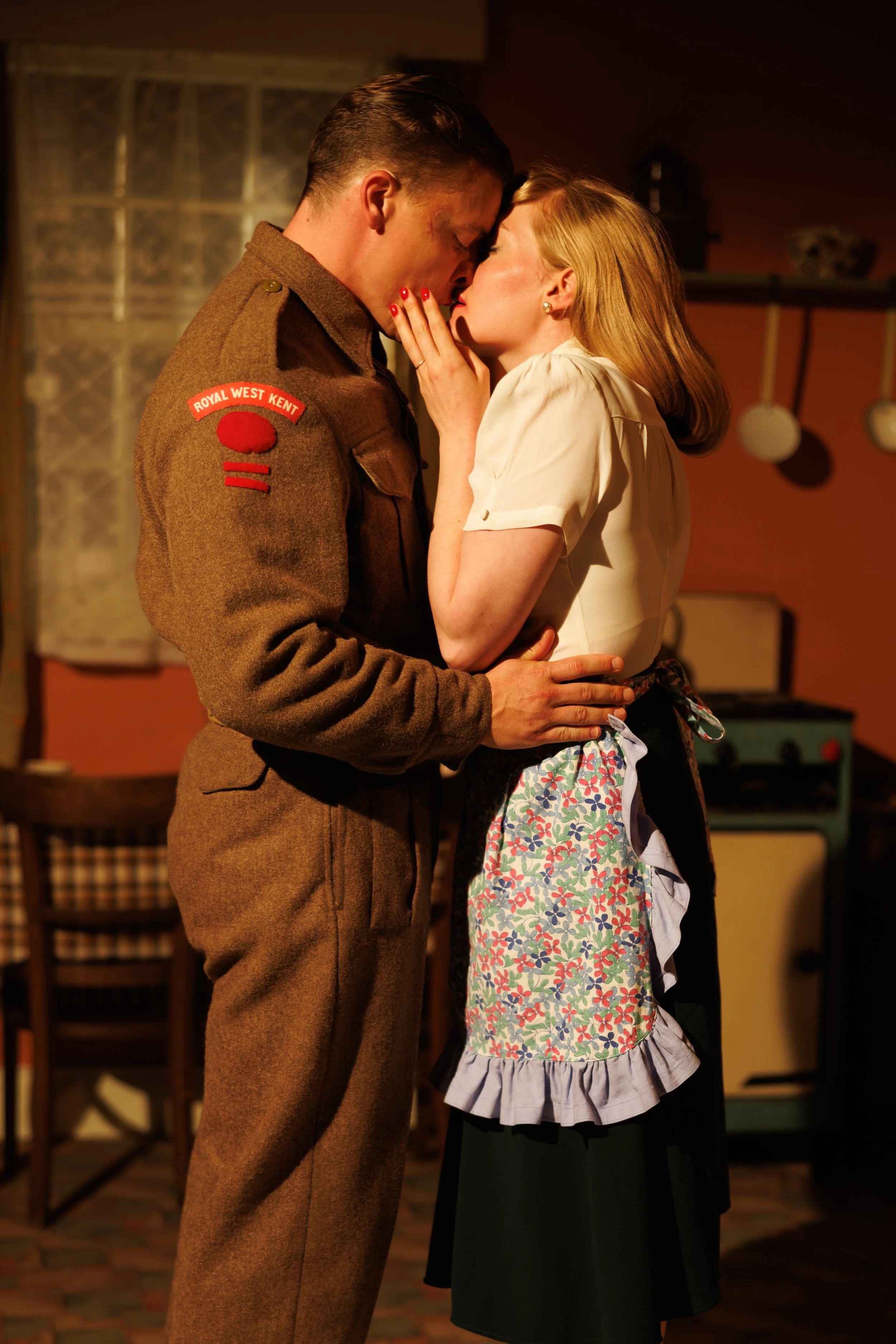
Jack Bandeira and Natalie Quarry - Think of England - Photo Credit - Vianney Le Caer