
Reform: Collected XX SS26 Fashion Lookbook
Words by Hamzah Asad
Whether we look through the lens of culture, politics or religion, our society has long tried to convince us of one thing: women are the architects of humanity’s downfall.
In the Christian Book of Genesis, Eve is cast as the vulnerable gateway, her single choice in Eden cementing the burden of Original Sin. In Islam, Adam and Hawwa stumbled together as equals and were forgiven as equals; yet, centuries of cultural folklore have stubbornly unspooled that divine equality, shifting the weight of temptation squarely back onto female shoulders. In Hindu tradition, we see Sita’s Agni Pariksha, where a woman is forced to walk through fire, tasked with proving her purity to absolve a chaotic world.
This inherited blame is as old as time, but so is the resistance to it. In 1990, the iconic Pakistani poet Kishwar Naheed wrote “Ye Hum Gunahgar Aurten Hain” (It Is We Sinful Women), fiercely interrogating this hereditary guilt. As we share the remaining verses of her poem, we trace the deep-rooted evolution of this blame and the ways it still haunts us.
Inspired by this dialogue, the Spring/Summer 2026 editorial by Collected XX serves as a visual exploration of how women are perceived in our society today. It asks a difficult question: have the rigid religious norms set centuries ago actually changed, or have they merely shapeshifted?
This campaign reflects a sobering reality. Even today, as society claims to have evolved and proudly celebrates the “Fourth Wave” of feminism, women too often remain objects in a man’s world. We are left to wonder if the rights and powers granted to us are genuine, or if they are merely theatrics, carefully crafted optical illusions meant to placate us while the old foundations remain untouched.
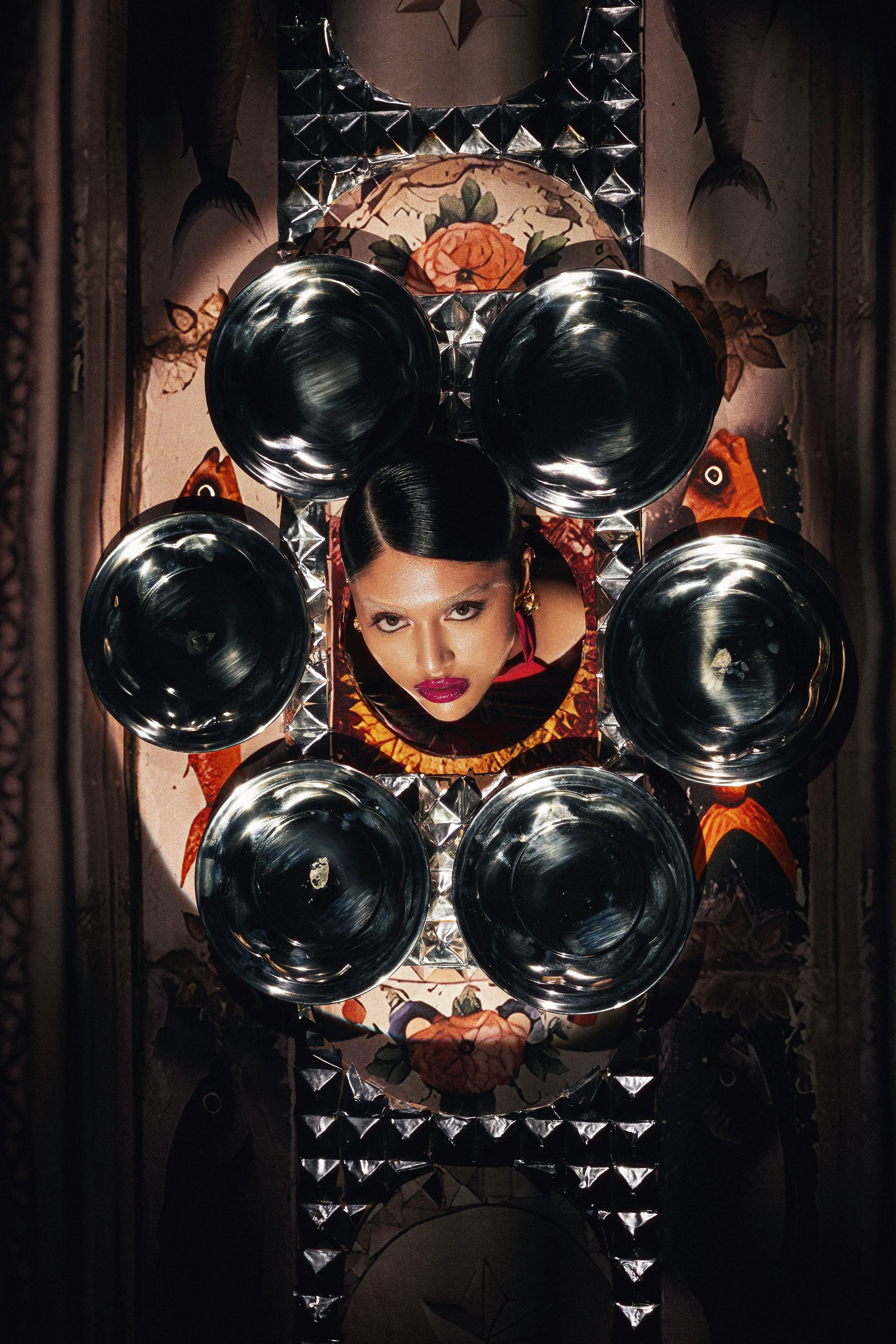
The most prominent element is the woman’s head protruding through the table, surrounded by empty, polished steel plates. She is quite literally being served up as a centrepiece on a platter. This echoes the idea that, despite societal evolution, women remain “objects in a man’s world”. She is presented for consumption, whether that means the consumption of her labour, her body, her purity or her guilt. The empty bowls suggest an insatiable societal appetite that she is expected to feed, yet she remains trapped at the centre.
While her make-up is bold and her presence is central, she is entirely immobilised. She has no hands visible to feed herself or to move the steel plates; she is constrained by the very table she is meant to decorate. This beautifully translates the idea that the rights and powers granted to women today are “merely theatrics or optical illusions”. She is given the spotlight but stripped of true, functional autonomy.
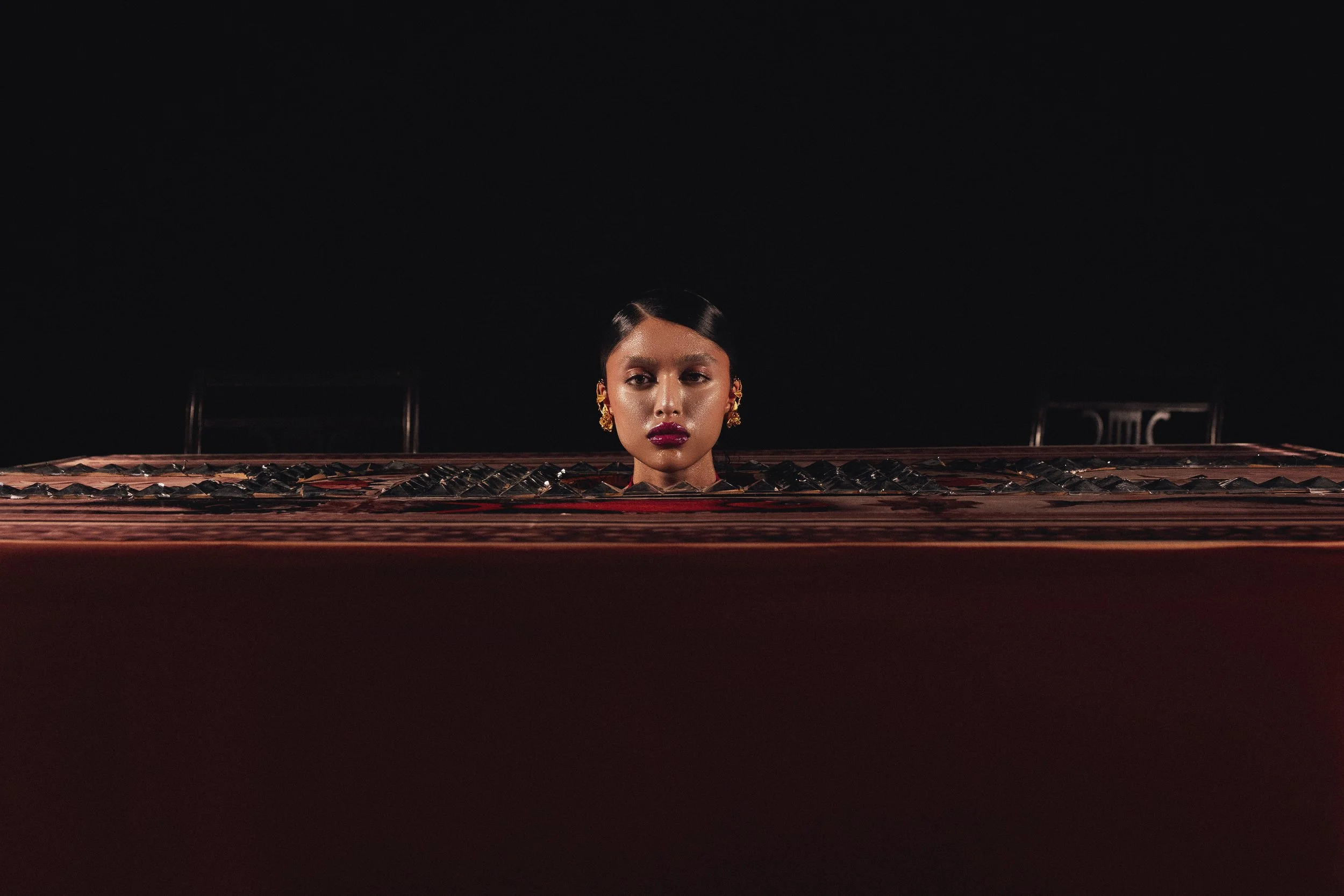
Seeing the table from afar, with her head completely disconnected from her body, reinforces the idea that her physical autonomy has been stripped away. She is reduced to a face, an object on display, unable to move or act.
The most haunting element of this image is the two empty chairs in the dark background. They suggest a tribunal or an audience. They represent the patriarchal structures, societal expectations or historical ghosts that demand this modern Agni Pariksha. The judges who shift the blame onto her do not even need to be present in the light; their system functions perfectly with them in the shadows.
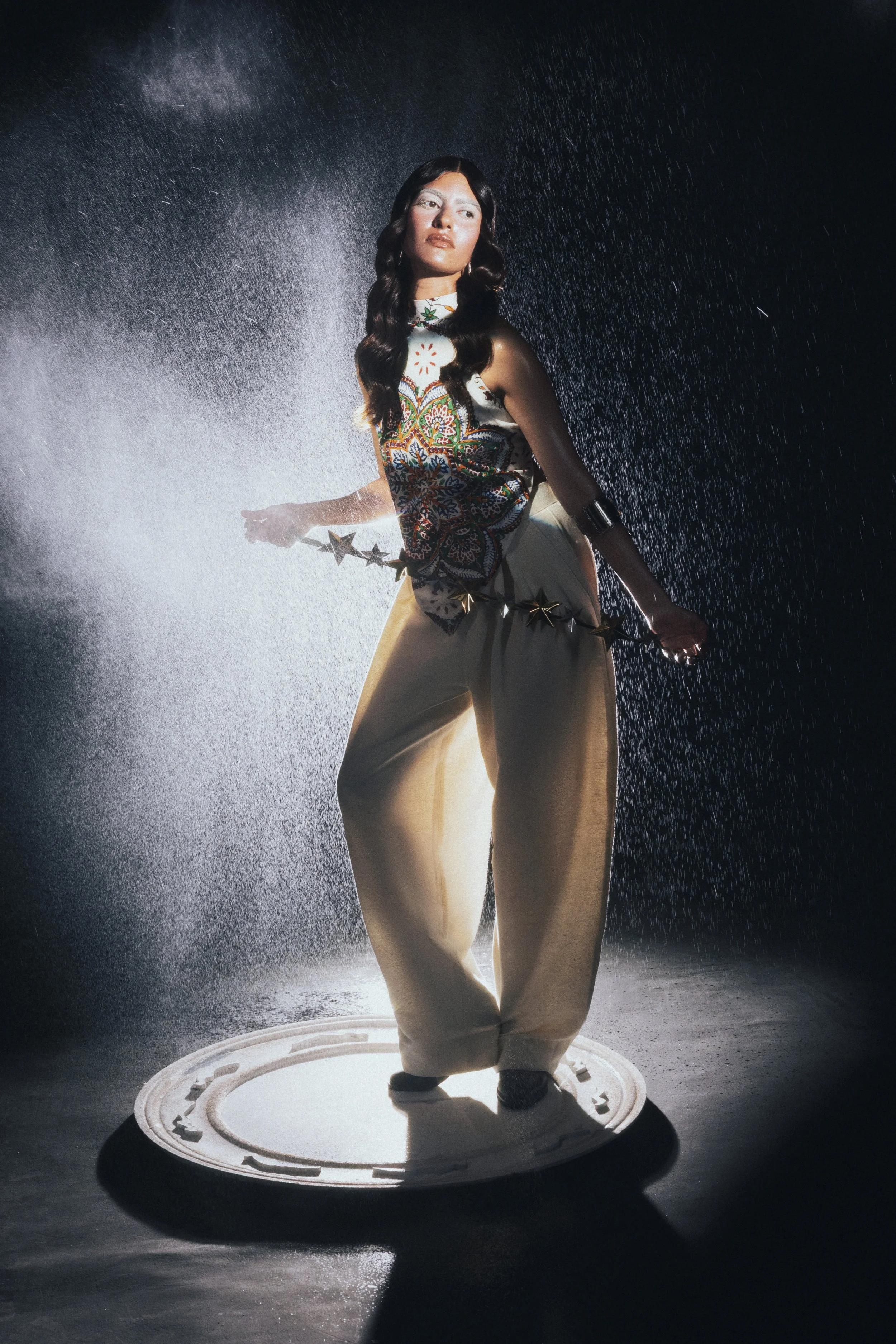
When society finally allows a woman to stand, it places her on a pedestal, but it is a trap, not a promotion. Standing under the atmospheric rain, she is confined to a small circular boundary made of unyielding steel. It does not offer her a foundation on which to thrive; it offers her an exact, restrictive boundary. If she takes a single step in any direction, she falls off. It is a trap disguised as elevation.
She is tasked with holding up the heavens, represented by the heavy star rod, while continuously proving her worth in a trial she never asked for.
Here, we see the ultimate trick of modern empowerment. Society has handed her glittering, celestial tools, the stars, but instead of guiding her, they blind her. The intense lens flares obscure her vision, perfectly capturing the “theatrics or optical illusions” of rights that are designed to restrict rather than liberate.
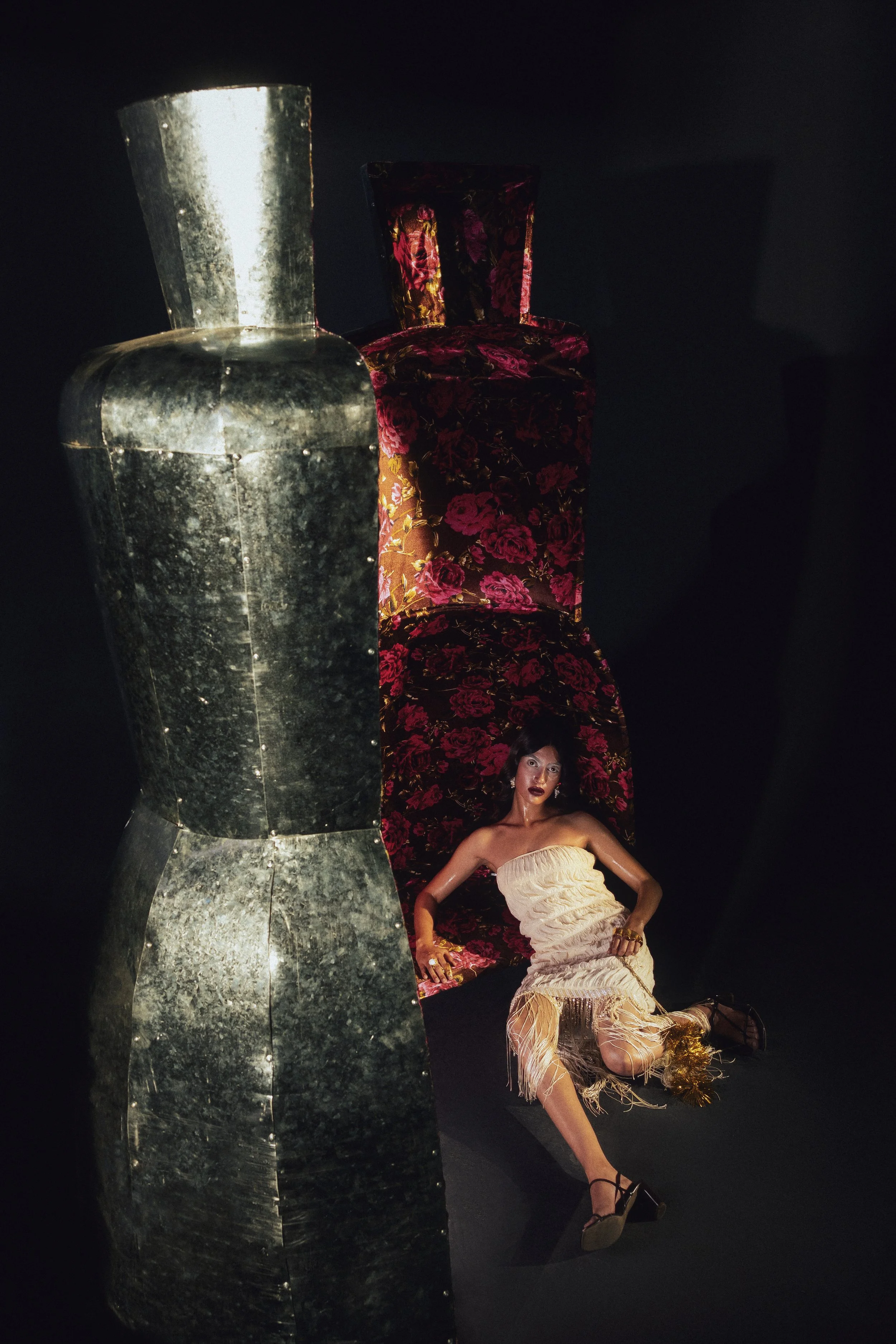
By transforming the traditional South Asian pattie, a trunk historically meant to hold a bride’s jahaiz (dowry), into the rigid, metallic silhouette of a woman’s body, this image delivers a devastating visual climax: she is not just bringing the dowry; she is the commodity.
Stuffed inside this hereditary sarcophagus, her existence is reduced to a generational transaction, physically swallowed by the heavy, inherited expectations of the past.
The true brilliance of the shot lies in the tension between the cold, industrial exterior and the plush, floral velvet lining, which serves as the ultimate symbol of the modern “Fourth Wave” illusion. The velvet dresses up her systemic confinement as luxury, care and elevation, whispering that she is revered and protected.
Yet, slumped within the casing like a broken, discarded doll, her posture reveals the sobering reality beneath the theatrics: no matter how soft or romantic the interior may be, she is still trapped inside a rigid patriarchal mould, proving that the ancient structures of objectification have not been dismantled; they have simply been lined with nicer velvet.
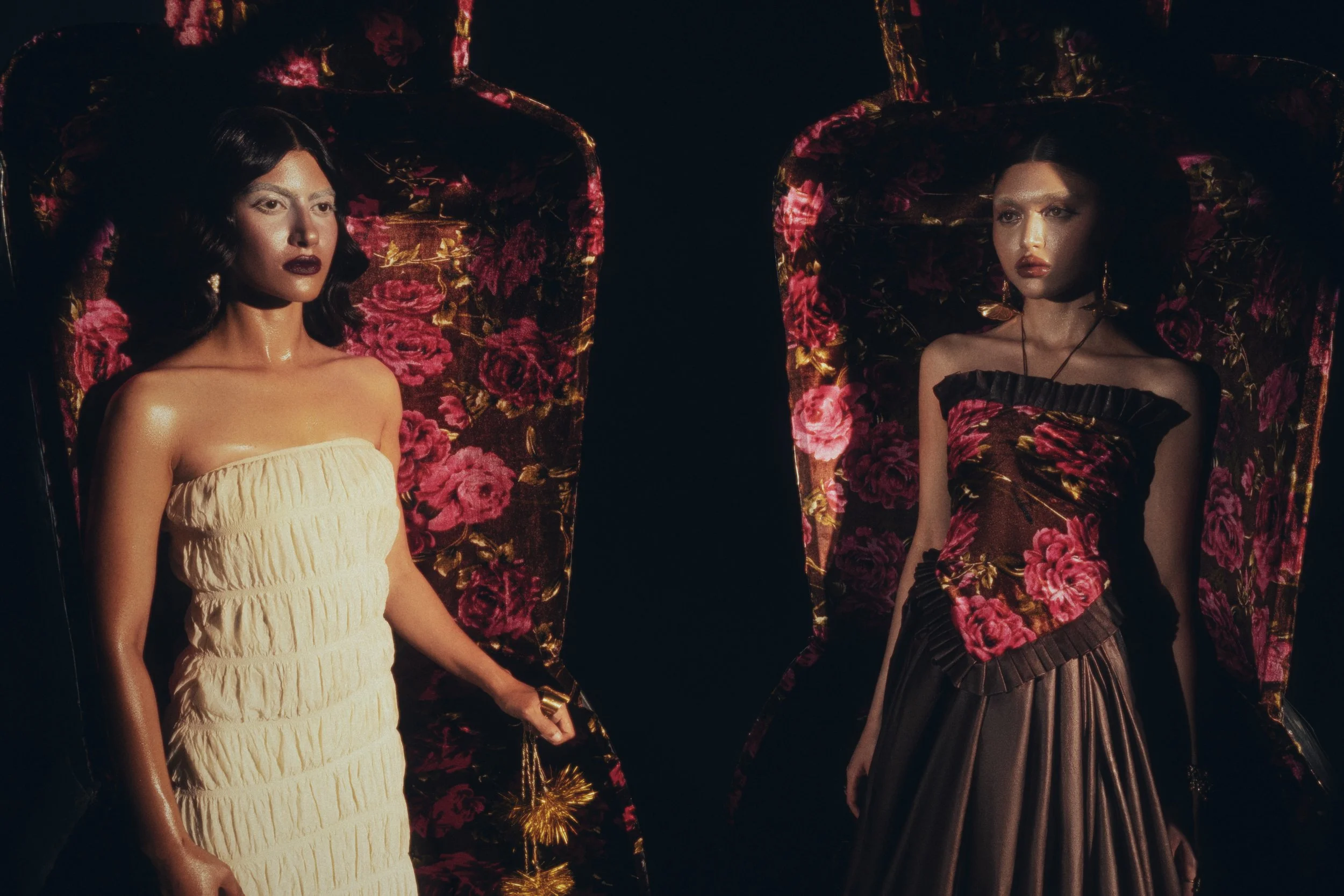
It offers a visual translation of the conceptual narrative surrounding the inherited expectations placed upon women, beautifully capturing the tension between individual identity and structural societal constraints. By confining the models within life-size, velvet-lined enclosures reminiscent of ornate jewellery boxes or doll packaging, the composition immediately evokes the feeling of being boxed into predetermined spaces and preserved for display.
This confinement is further emphasised through deliberate styling choices. The model on the right is almost swallowed by her environment, wearing a bodice that seamlessly assimilates with the heavy, romantic floral lining to represent conformity, while the model on the left provides a stark contrast in her textured cream dress, yet remains trapped within the exact same structural boundaries. Adding to this dramatic tension is the statuesque rawness of the models’ “wet-look” skin and hair, which introduces a glazed vulnerability that powerfully juxtaposes the dark, traditional weight of the rose motifs enclosing them.
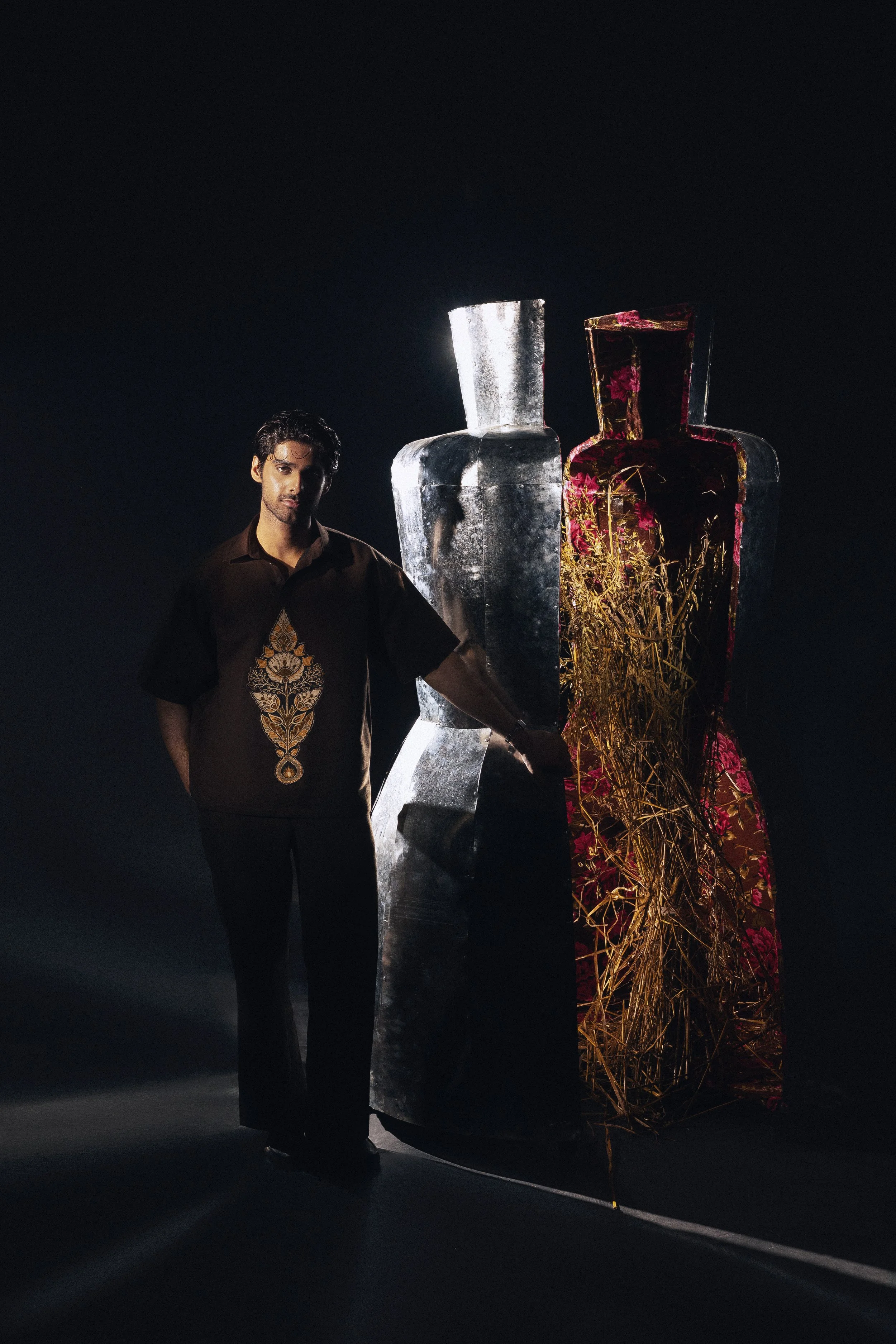
The harsh, riveted metal structure is no longer just a visual prop; it is an industrial mould built to confine and shape women to an impossible standard. By stuffing that mould with raw wheat, the female form is reduced to a literal harvest, a commodity expected to provide endless domestic sustenance, crushed inside a rigid framework simply to be deemed presentable to the world.
Standing beside this suffocating confinement is the male figure, inherently accepted and effortlessly validated in his natural state. The contrast is deafening. He does not need to be heavily styled or packaged to be respected; he is entirely unburdened by the heavy expectations placed upon the opposing feminine form.
The execution of the Gandum Shirt and Pants is where the narrative truly peaks.
While the female form is represented by raw, withered stalks crammed into a box, the male figure gets to wear the refined, celebrated version of it. The meticulously crafted wheat-flower appliqué takes authentic artisanal craft and elevates it into a modern, architectural silhouette. It brilliantly uses the very symbol of the woman’s confinement as the structural centrepiece of his effortless elegance.
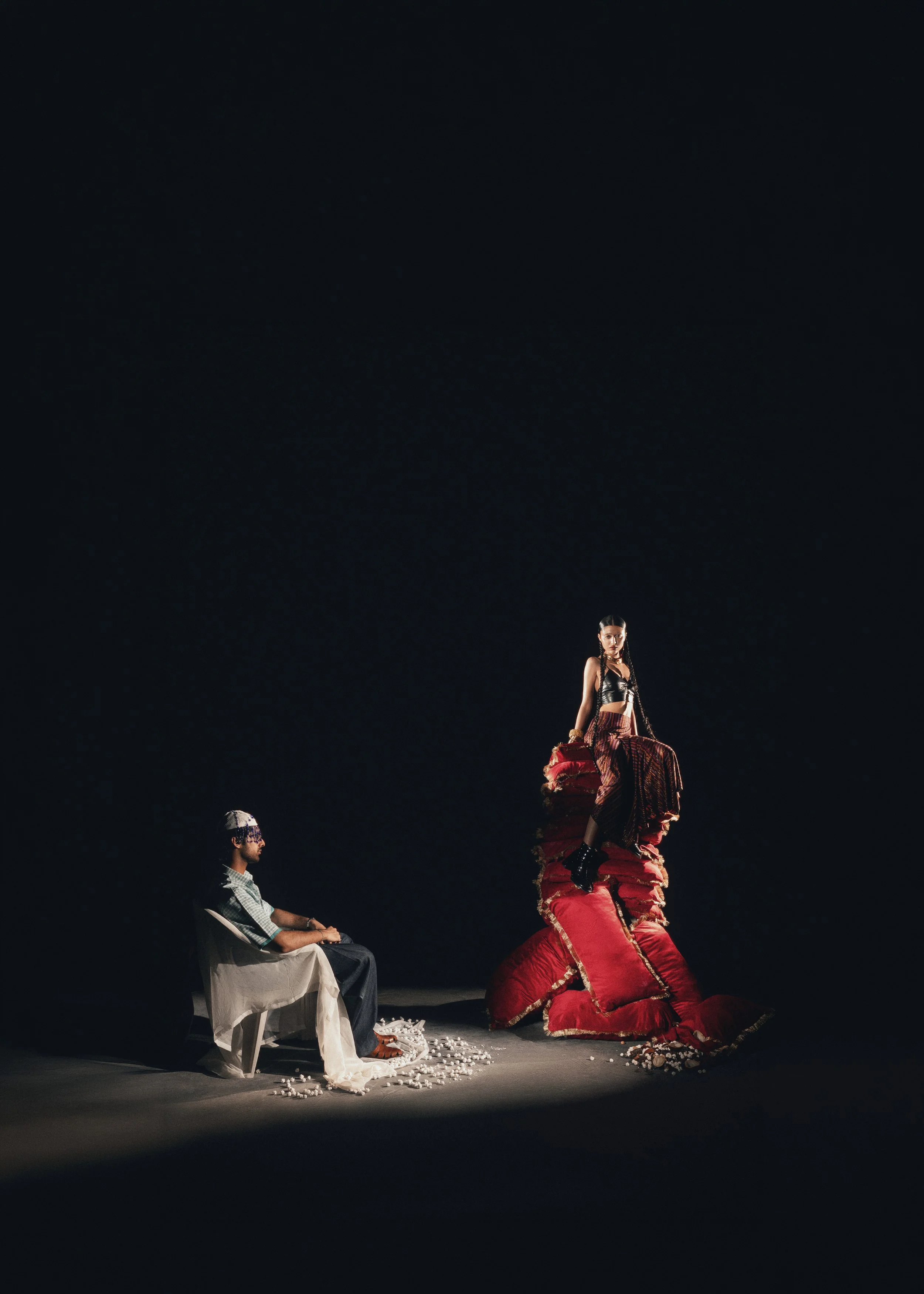
This image offers a critique of inherited expectations through the cultural lens of the Bidh tradition. A towering, precarious installation of red velvet sacks, representing the Bidh (customary sweets and dried fruits distributed by a bride’s family to announce a marriage), serves as a literal pedestal of financial and societal obligation. Perched atop this unstable monument to tradition is the female figure, styled with deliberate structural rigidity and performative elegance.
In stark contrast, the male figure sits grounded and unburdened on a plastic chair, his relaxed posture illustrating a profound disparity in societal demands. The narrative is further anchored by spilled makhanay (lotus seeds) scattered across the floor, visually symbolising the outpouring of the bride’s family’s wealth and effort, laid at the feet of the casually seated groom. Through striking modern silhouettes and rich visual metaphors, the composition transforms a deeply rooted regional custom into a compelling theatrical commentary on gender dynamics.
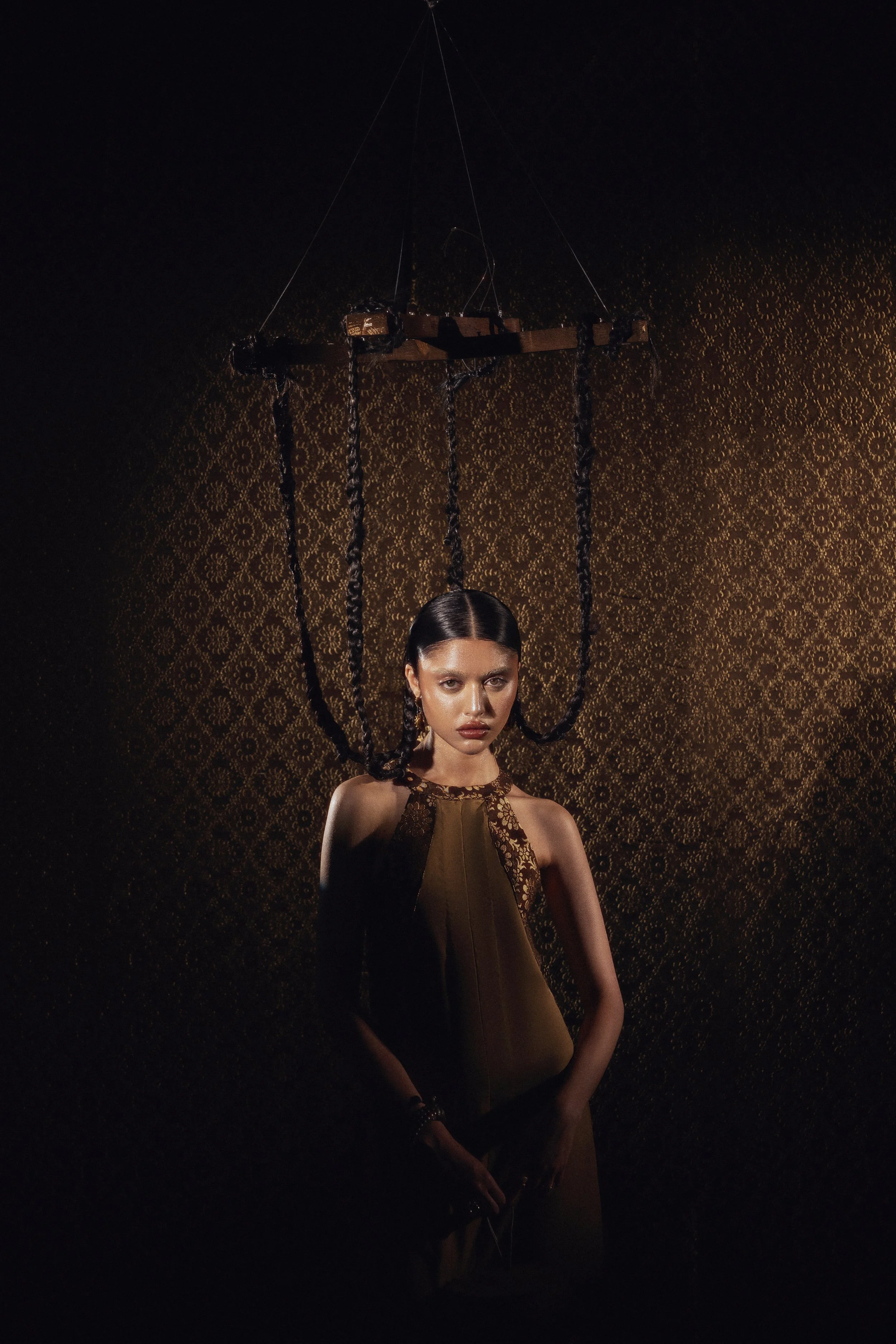
This image offers a visceral critique of autonomy and inherited expectations by transforming the female form into a living marionette. By utilising the model’s own braided hair as the literal puppet strings, suspended from a crude wooden crossbar, the composition suggests that the instruments of control are deeply internalised, rooted in the very physical identity and familial ties she has been raised to uphold.
This narrative of inescapable confinement is amplified by the styling: the model’s dress incorporates the exact same rich jacquard as the backdrop. This deliberate material assimilation visually camouflages her within her surroundings, serving as a powerful metaphor for an individual’s identity being swallowed by the heavy, historical fabric of her cultural environment.
Bathed in dramatic, isolating light, her performative stillness captures the haunting reality of navigating life while physically tethered to, and visually consumed by, societal design. It evokes the perpetual scrutiny of Sita’s Agni Pariksha, visually representing how women are continuously subjected to the flames of societal trial in order to prove their compliance. Yet, in her unwavering gaze lies the quiet defiance of Kishwar Naheed’s “Ye Hum Gunahgar Aurten Hain” (It Is We Sinful Women), a resolute acknowledgement that to exist beyond these inherited strings is to boldly reclaim the narrative of the rebel.
Brand: https://www.instagram.com/collectedxx
Photographer: https://www.instagram.com/shahrozhyder
Videographer: https://www.instagram.com/hassaan._.sajid
Models:
https://www.instagram.com/farihaonearth
https://www.instagram.com/sukainaazaidi
https://www.instagram.com/abdurafay_
MUA: https://www.instagram.com/makeupbyshainal
Art Direction:
https://www.instagram.com/thebackdropofficial
https://www.instagram.com/owaiskzaffar
https://www.instagram.com/waqas5manj
Stylist: https://www.instagram.com/haiyab
Hair: https://www.instagram.com/hairbyashbeel
Project Manager:
https://www.instagram.com/bymariam____
https://www.instagram.com/shaheerahmad.tz
Creative Direction:
https://www.instagram.com/naelhaf
https://www.instagram.com/hamzahsewsnsues
Studio & Production: https://www.instagram.com/ayproductions.pk