
Between Sleep and Walking: Aadhya Deshmukh’s New Collection ‘Pause’
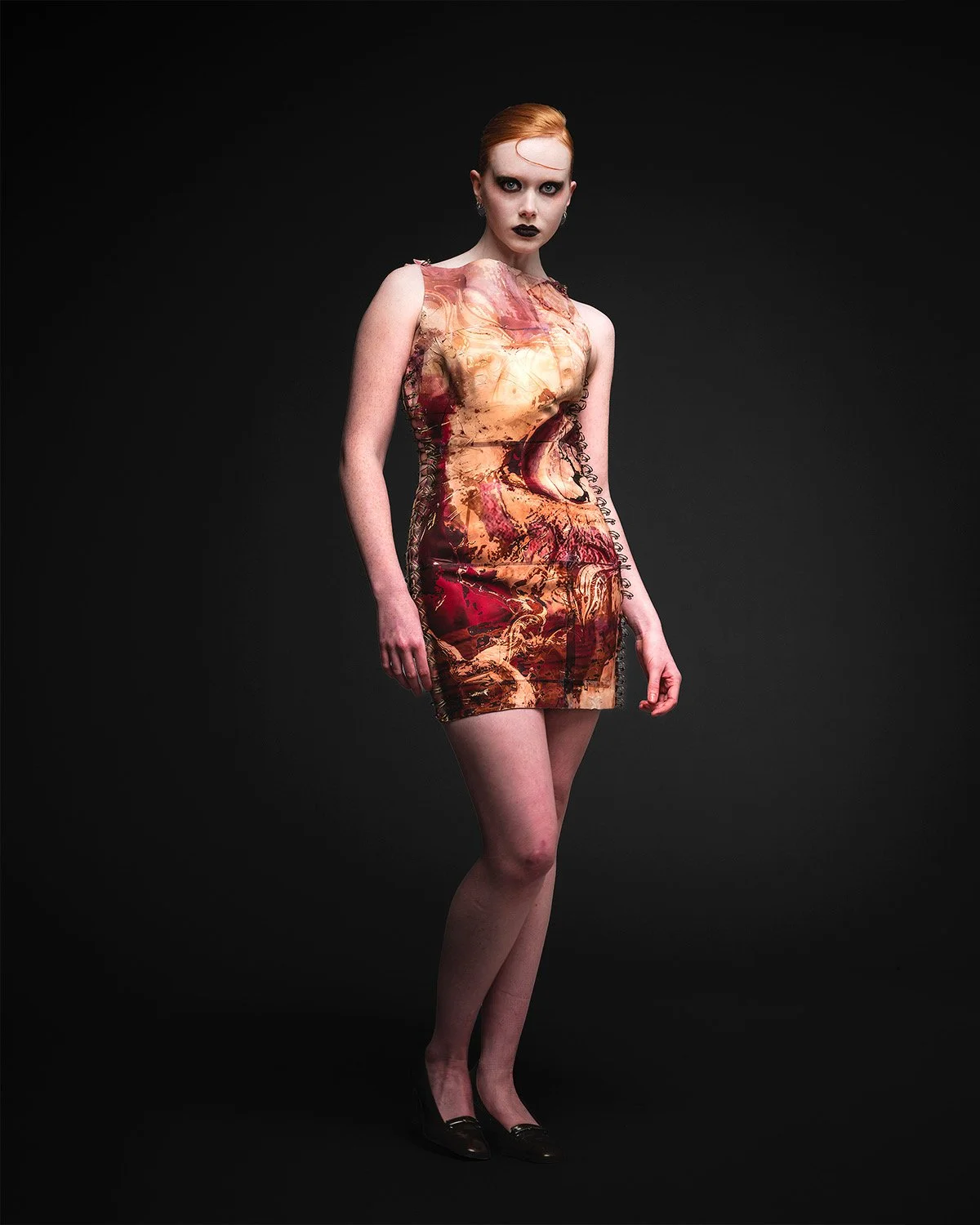
Following years of technical training at the Fashion Institute of Technology in New York, Aadhya Deshmukh has released ‘Pause’, her new ready to wear collection that explores the liminal spaces between who we are and what we’re experiencing. The collection is intended to be an exploration of phenomena such as sleep paralysis, transcending psychological evidencing to sit in the discomfort of how it can feel when you can’t escape your own senses.
Having moved to New York at 17 years old, she adapted to the fast-paced environment quickly, balancing studio hours, academia and professional commitments alongside fostering inspiration for her next collection. Having worked previously for Grace Ling and Oscar de la Renta, couture-level standards eminate through her own personal label’s work.
Aadhya Deshmukh’s Pause is built around the feeling of being present but unable to move forward, taking sleep paralysis and everyday dissociation as its starting point. Rather than forcing that idea through on the nose theatrical styling or overworked symbolism, she lets materials, surfaces, and silhouette do the talking.
Muted tones dominate the collection and complement the silhouettes and patterns without creating overwhelming designs. Blacks, dark greens, washed neutrals and deep reds recur throughout, giving the collection a heavy, nocturnal feel. That refinement of colour allows the more unusual fabric developments and painted surfaces to take centre stage without overwhelming the wearer.
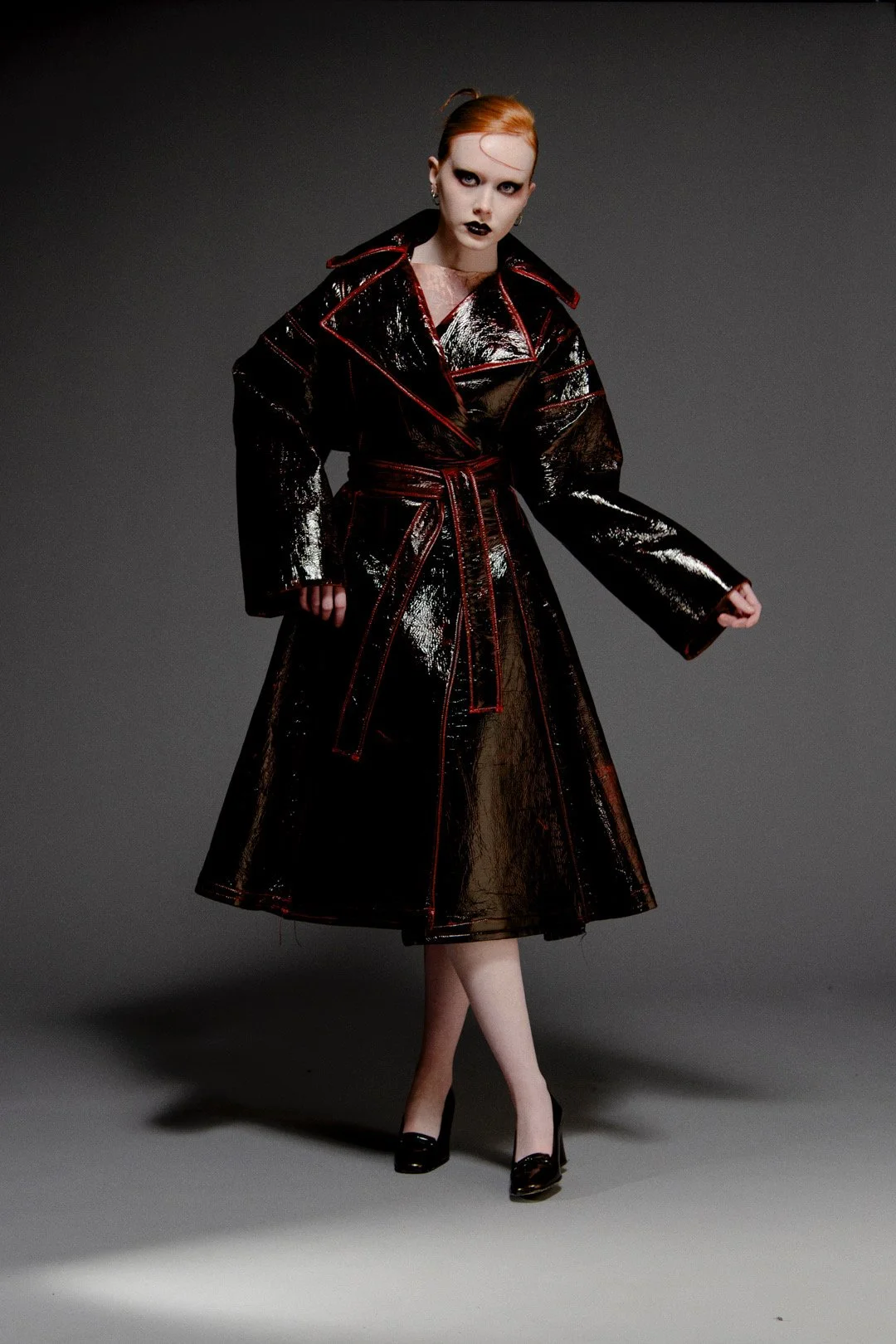
The collection is at its strongest when it focuses on how fabric can be changed to echo emotional states. A heat reactive trench coat, developed by Deshmukh, shifts to a bright hot red around the collar and edges when activated by warmth, before fading away again, feels like a living embodiment of themes surrounding the collection. How do we notice and acknowledge the feelings within ourselves in response to over environment? How do those emotions change depending on what’s around us? It is one of the clearest expressions of the collection’s central idea. The garment itself remains sharply shaped and familiar, but its surface behaves unpredictably, as though something internal has briefly risen to visibility. As a statement piece this is probably our favourite item.
That interest in altered material continues elsewhere. A leather coat is overlaid with melted PVC raincoat material, creating a disturbed, glossy surface that feels less polished than unsettled. In another look, Deshmukh develops her own textile from three layers of corduroy, tulle and clear PVC, melting the upper materials onto the corduroy to create a dense, tactile puffer. These are the moments where the collection becomes most distinct, and fabric manipulation comes to the foreground as Deshmukh’s fashion signature.
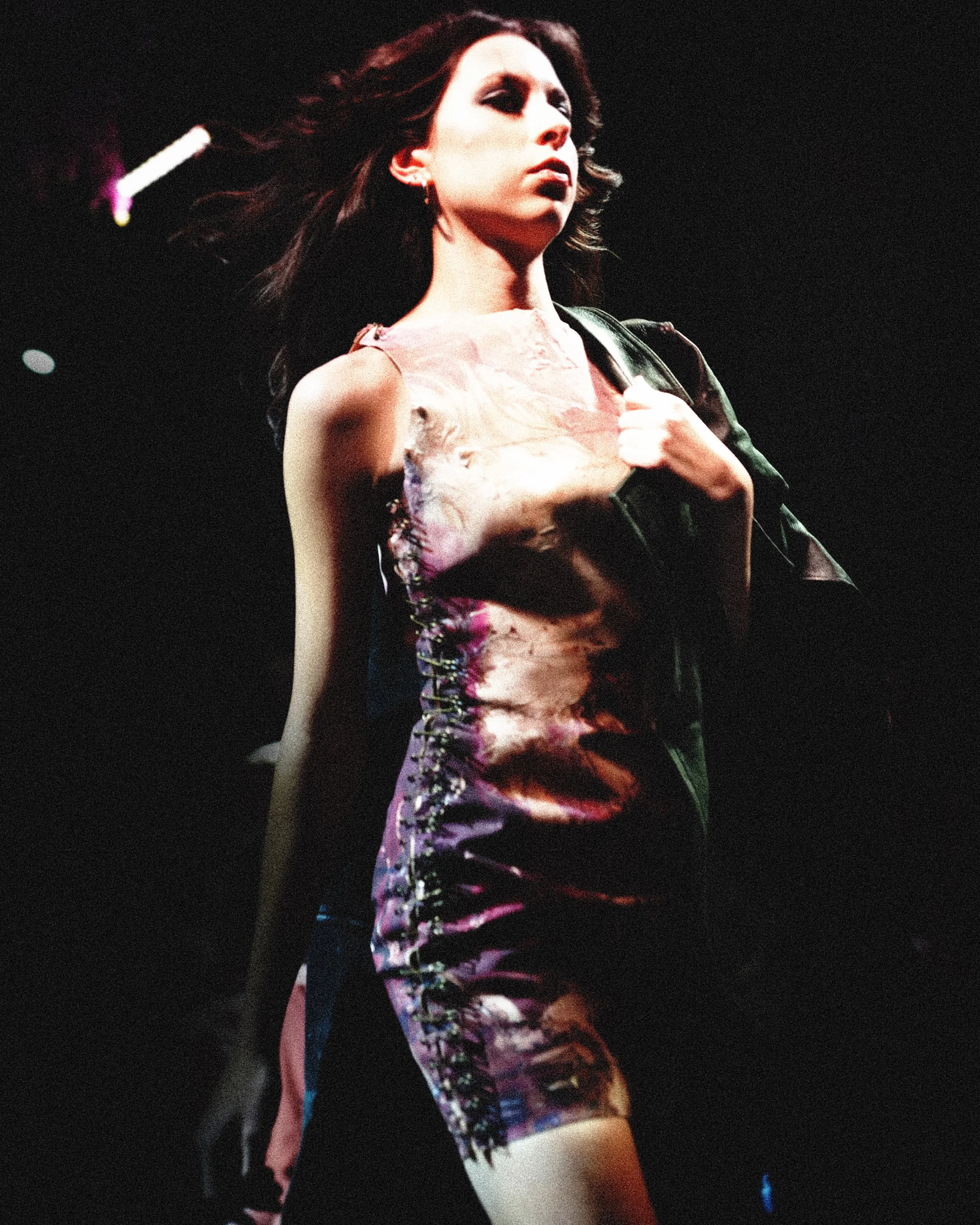
Print is used beautifully within the collection, a mixture of refined pinstripe fabrics and intricately detailed artworks displayed on the body. Hand printing and painting appear across a sculpted leather top and a fitted leather dress, both tied to Deshmukh’s idea of eerie stillness and the sensation of being the only immovable object in a world that does not wait. The imagery has a blurred, almost uneasy quality, and because it is applied to garments cut close to the body, it feels integrated into the silhouette. The emotions explored within the collection cling to the body, held against us with large metal safety pins, the inescapable and unavoidable instincts so many people experience but cannot name.
Silhouettes that hold and accentuate the body appear throughout the collection. Sculpted leather dresses and tops sit close to the torso, giving certain looks a rigid, contained quality alongside exquisite moulded tailoring. One of the strongest examples is the fitted leather dress with safety pins running up the side seams, styled again later with the leather poncho from the opening look. The visible pins stop the piece from becoming too sleek in our opinion - the collection never lets itself become too polished and refined.
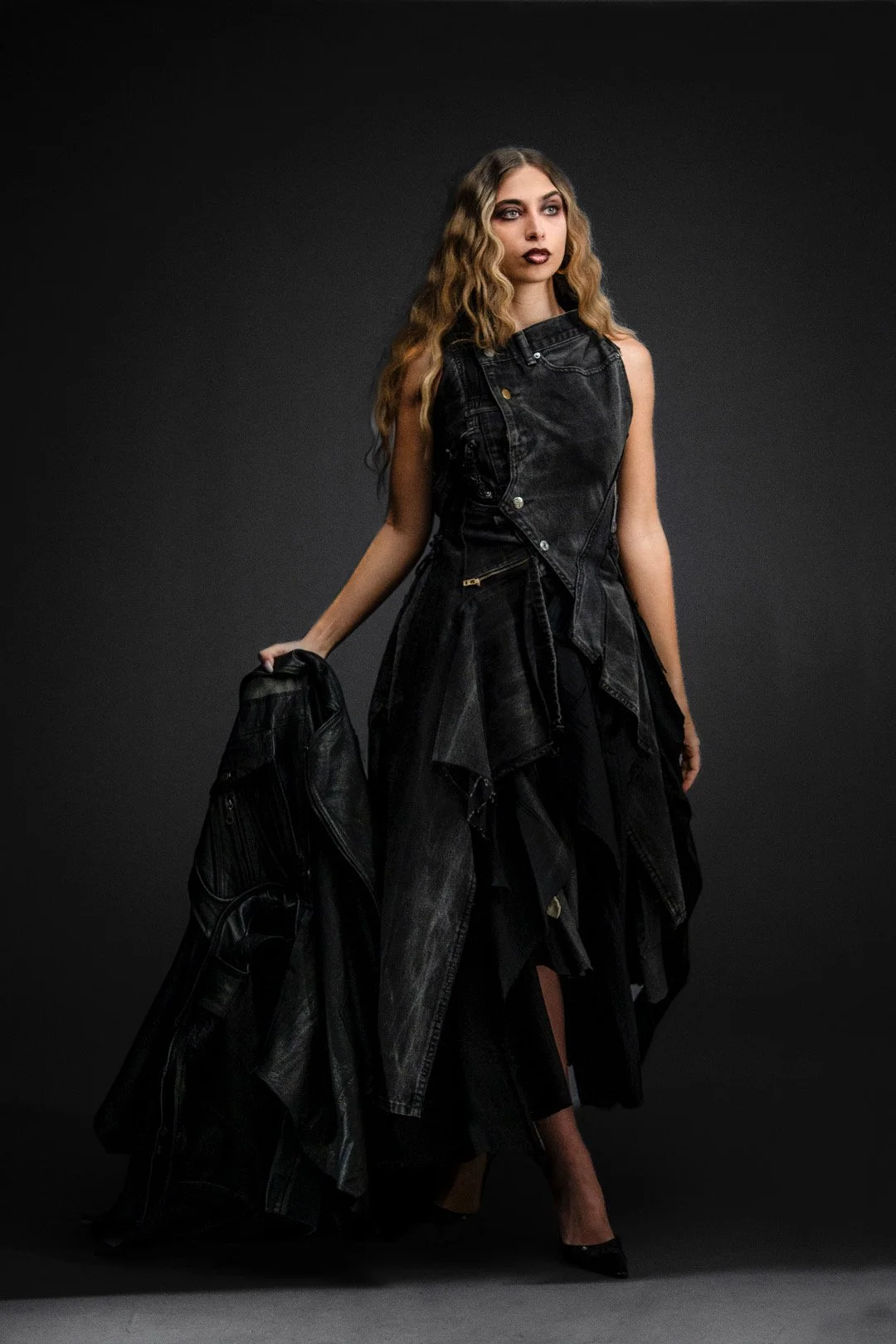
The opening look also introduces Deshmukh’s interest in reworking existing garments. Upcycled denim jeans are turned into a top, while pinstriped trousers are reconstructed as a skirt. Worn with a real leather poncho, the look sets up several of the collection’s concerns at once: transformation, layering, and the repurposing of familiar materials into something more psychologically charged. The reworked jeans top reminds us of something Fecal Matter would’ve designed when they first came around, transforming familiar existing garments into fresh new designs in a way that makes it look so easy to do (but is absolutely not in practice.) This look gives me this feeling of meeting someone who’s name is on the tip of your tongue.
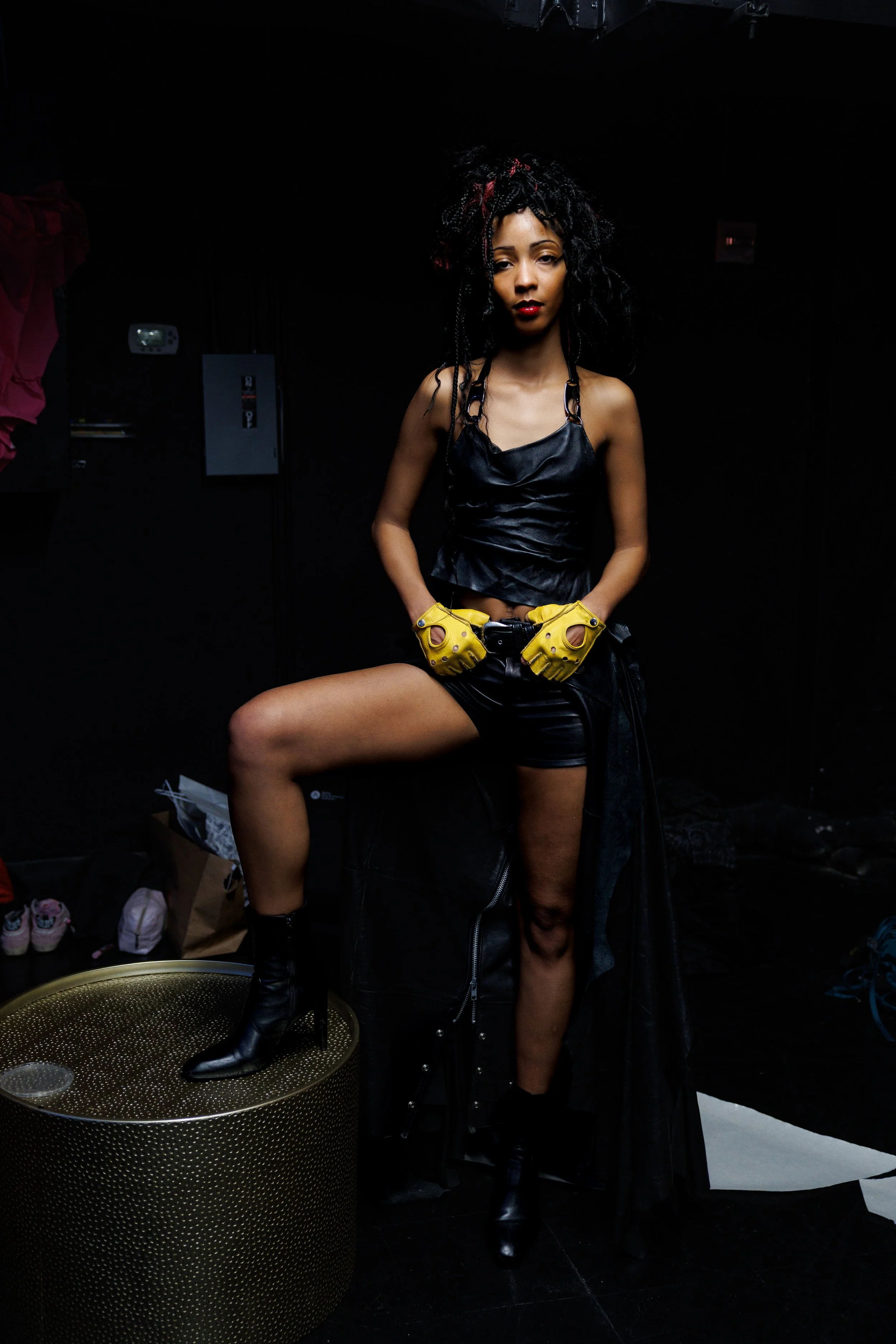
Elsewhere, Deshmukh works with real leather skins to create full chaps that act visually almost like skirts because of their volume and movement. That fullness gives the look wear wearability than traditional chaps and its the ambiguity of Deshmukh’s designs that we love. It gives the looks a shifting outline that changes as the model moves, making the silhouette feel less fixed than it first appears.
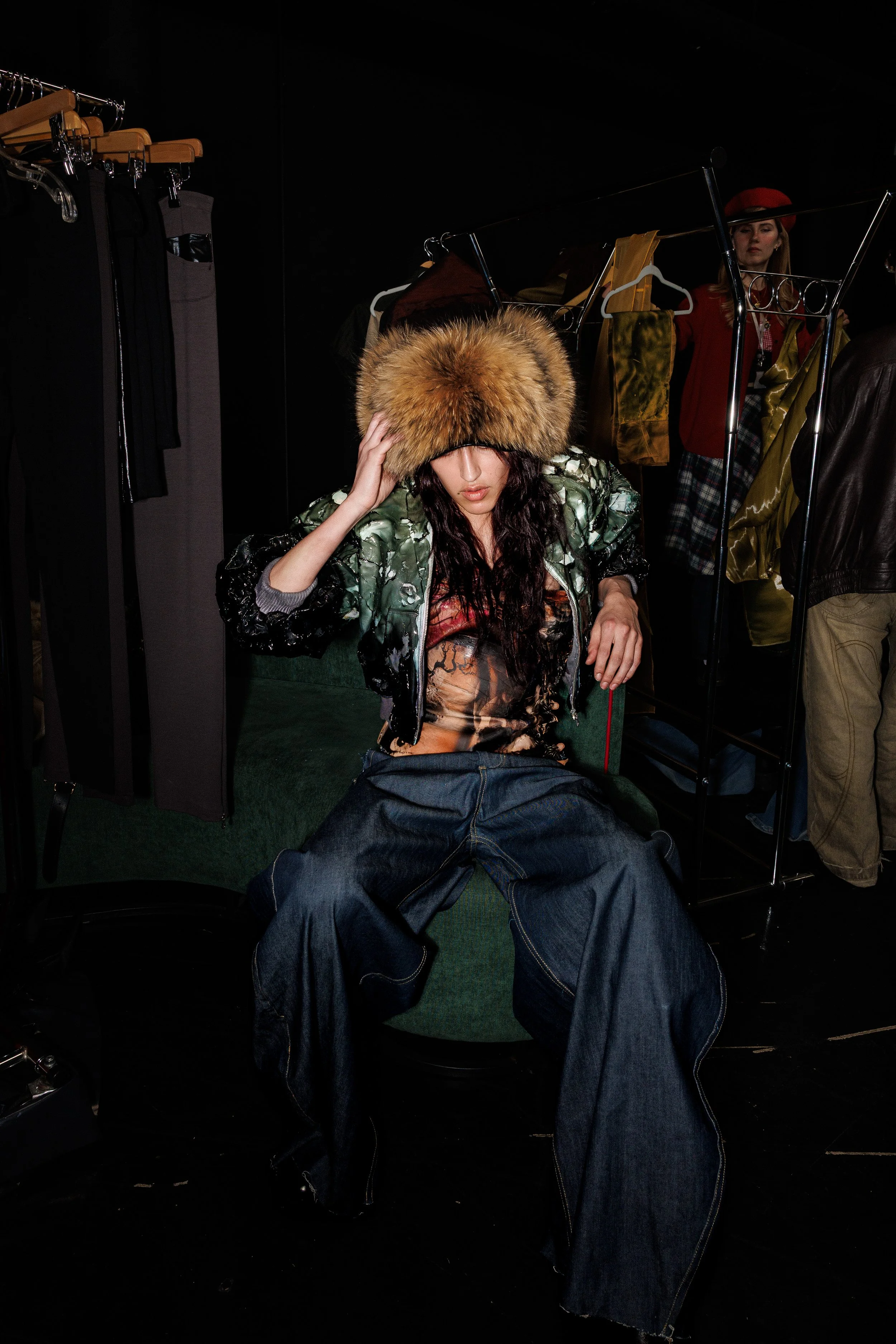
There are moments where the styling pulls the collection towards a more casual contemporary language, particularly with the balloon-leg jeans and oversized fur hat akin to a Jaded London look or Minga, for example, but even there the material experimentation keeps the work from becoming too familiar. The strongest looks are the ones where Deshmukh trusts her fabric development and sculpted shapes to carry the point. She thoughtfully explores textile experimentation without making it look like an A-Level art project and her commitment to upcycling high quality natural materials like leather and cotton denim show a respect for the natural as well as man made.
What makes Pause compelling is not that it tries to explain paralysis literally, but that it finds ways to make clothing behave in relation to it. Surfaces react, leather is painted and shaped into something bodily and uneasy, and familiar garments are remade so they no longer sit quite as expected. Reviewing this collection was an experience in and of itself - at first glance none of these garments are as they appear and thankfully - in all of the best ways.